The Trimurti: Brahma, Vishnu, and Shiva Explained
Somewhere between the first sound of creation and the final breath before dissolution, Hindu philosophy places three cosmic forces on a single stage. One brings the universe into being. One holds it steady through the noise of time. One clears it away so a new story can begin. Together, they are called the Trimurti — Sanatan Dharma’s answer to a question every civilization has asked: who runs the universe, and how?
If you have ever wondered why India is filled with thousands of Shiva and Vishnu temples but only one major temple dedicated to Brahma, you have already brushed up against the mystery at the heart of this article. Why does the “Creator” fade into the background while the “Preserver” and the “Destroyer” remain at the center of daily worship? Why is Vishnu pictured resting calmly on a cosmic serpent while Shiva sits in fierce meditation on a frozen Himalayan peak? And why, despite appearing so different, are these three gods described in scripture as expressions of one and the same formless reality?
This guide unpacks the Trimurti — Brahma, Vishnu, and Shiva — in plain, engaging language, while staying rooted in the Vedas, Puranas, and Itihasas that gave rise to this idea. Whether you are a devotee deepening your understanding, a student researching Hindu philosophy, or simply a curious reader who stumbled onto this page through Google Discover, you will leave with a clear, accurate picture of who the Trimurti are, what they symbolize, and why this concept still shapes Hindu thought today.
Quick Summary: The Trimurti is the Hindu triad of Brahma (the Creator), Vishnu (the Preserver), and Shiva (the Destroyer/Transformer). Together they represent the three essential functions of the universe — creation, preservation, and dissolution — which Hindu philosophy sees as a continuous, cyclical process rather than a one-time event.
Table of Contents
What is the Trimurti?
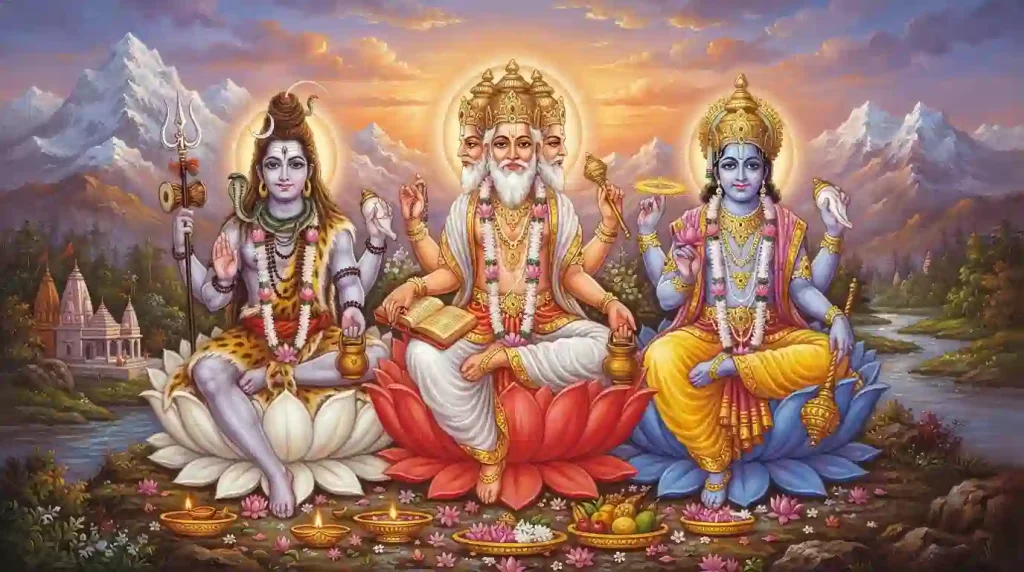
The Trimurti (Sanskrit: त्रिमूर्ति) is the group of three principal deities in Hinduism — Brahma, Vishnu, and Shiva — each responsible for one of the three fundamental cosmic functions:
Deity | Cosmic Role | Core Function |
Brahma | The Creator | Brings the universe into existence |
Vishnu | The Preserver | Sustains and protects creation |
Shiva | The Destroyer/Transformer | Dissolves creation to allow renewal |
Rather than three separate, competing gods, most schools of Hindu philosophy see the Trimurti as three roles performed by a single, ultimate reality — sometimes identified with Brahman, the formless, infinite consciousness described in the Upanishads. Creation, preservation, and destruction are not viewed as opposing forces but as one continuous, cyclical rhythm, much like a heartbeat: expansion, sustenance, and contraction, endlessly repeating.
Did You Know? The word “destruction” in Shiva’s role does not mean evil or violence. In Hindu thought, destruction is simply the necessary clearing away of what is old, worn out, or complete — so that new creation can begin.
Meaning of Trimurti
The word Trimurti comes from two Sanskrit roots:
- Tri (त्रि) meaning “three”
- Murti (मूर्ति) meaning “form” or “manifestation”
So, Trimurti literally translates to “three forms” — the three visible manifestations of the one formless, supreme cosmic principle. This is an important distinction: in Hindu philosophy, Brahma, Vishnu, and Shiva are not three separate, independent beings competing for power. They are three murtis, or forms, through which the same underlying divine reality expresses itself in the world.
Think of it like sunlight passing through a prism. The light itself is one, but it appears to us in different colors depending on the angle and the medium. In the same way, the infinite divine appears as Brahma when creating, as Vishnu when sustaining, and as Shiva when transforming.
Origin of the Trimurti
The idea of three divine functions did not appear overnight — it developed gradually across centuries of Vedic and post-Vedic literature.
- Rigveda (c. 1500–1200 BCE): The earliest Vedic hymns do not present a formal “Trimurti.” Instead, they celebrate a wide pantheon of devas, with figures like Agni, Indra, Varuna, and Surya playing prominent roles. However, the philosophical seeds of a triadic cosmic order — creation, order, and dissolution — are already present in hymns describing cosmic sacrifice and universal law (Rita).
- Brahmanas and Upanishads: As Vedic thought matured, the focus shifted toward a single, formless absolute reality — Brahman — from which everything, including the gods, emerges. This laid the philosophical groundwork for later traditions to see multiple deities as expressions of one truth.
- Epics and Puranas (roughly 400 BCE–500 CE onward): The formal grouping of Brahma, Vishnu, and Shiva as a functional triad becomes clearer in texts like the Mahabharata, and is fully developed in the Puranas, especially the Vishnu Purana, Shiva Purana, and Linga Purana, where each deity is described performing his respective cosmic role in an ongoing cycle.
It’s worth noting that Hindu tradition is not monolithic. Vaishnavas (devotees of Vishnu) and Shaivas (devotees of Shiva) each have texts that describe their chosen deity as the supreme, ultimate source of all reality — with the other two members of the Trimurti emerging from or serving that supreme god. The Trimurti concept itself is often understood as a unifying framework that later tradition used to harmonize these different devotional streams, rather than a single uncontested doctrine present from the very beginning.
The Philosophy Behind the Hindu Trinity
Why three gods, and not one, or ten? The philosophy behind the Trimurti reflects a deeply Hindu way of understanding time and existence.
A Cyclical, Not Linear, Universe
Many world traditions imagine time as a straight line — a beginning, a middle, and a final end. Hindu cosmology, by contrast, sees time as cyclical. Universes are created, sustained, and dissolved, only to be created again. This is described using enormous time cycles called Kalpas, within which smaller cycles called Yugas (Satya, Treta, Dvapara, and Kali) repeat endlessly.
The Trimurti maps directly onto this worldview:
- Brahma initiates a new cycle of creation.
- Vishnu maintains balance (dharma) throughout the cycle.
- Shiva dissolves the cycle when it reaches completion, making way for the next Brahma to begin again.
Unity Behind Diversity
A recurring theme across Vedantic philosophy is that ultimate reality is one without a second (Ekam sat, as the Rigveda famously states — “Truth is one, the wise call it by many names”). The Trimurti is one of Hinduism’s most elegant ways of expressing this unity-in-diversity: three faces, one truth.
Expert Insight: Many scholars describe the Trimurti not as “three gods” in the Western polytheistic sense, but as three functional aspects of a single divine intelligence, similar to how one person can simultaneously be a parent, a professional, and a friend — different roles, same individual.
Lord Brahma: The Creator
Birth of Brahma
According to several Puranic accounts, Brahma was born from a lotus that emerged from the navel of Lord Vishnu, as Vishnu lay in cosmic sleep on the serpent Shesha in the primordial waters. This is why Brahma is often called Nabhija, meaning “navel-born.” Other traditions, particularly within Shaivism, describe Brahma as having emerged from Shiva. As with much of Hindu mythology, different scriptures preserve different versions, reflecting the theological perspective of the tradition that recorded them.
Symbolism
Brahma embodies the creative force of the universe — knowledge, intellect, and the impulse that turns formless potential into form. He is closely associated with the Vedas, learning, and the very fabric of creation itself.
Four Faces Meaning
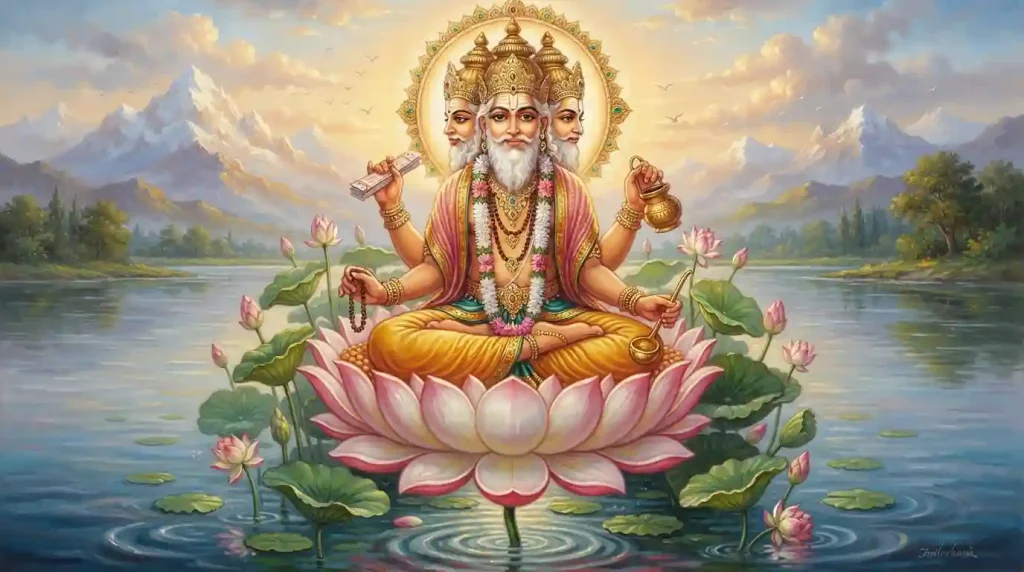
Brahma is traditionally depicted with four heads, said to represent:
- The four Vedas (Rigveda, Yajurveda, Samaveda, Atharvaveda)
- The four directions (North, South, East, West), symbolizing his all-seeing awareness over creation
- The four stages of human life (Ashramas): student, householder, retiree, and renunciate
- The four yugas, or ages of time
Some Puranic stories say Brahma originally had a fifth head, which was removed by Shiva to curb Brahma’s arrogance — a tale found in the Shiva Purana, illustrating the value Hindu philosophy places on humility even for the Creator.
Vehicle
Brahma’s vehicle (vahana) is the swan (Hamsa), a symbol of discrimination — the mythological ability to separate milk from water, representing the power to distinguish truth from illusion, and good from evil.
Consort Saraswati
Brahma’s consort is Saraswati, the goddess of knowledge, wisdom, music, and the arts. Their union represents the inseparable bond between creation and knowledge — nothing can be truly created without wisdom to guide it.
Weapons and Attributes
Brahma is typically shown holding:
- A water pot (kamandalu) — symbolizing the primordial waters from which creation arises
- A string of prayer beads (akshamala) — representing time and the cyclical counting of the universe
- The Vedas — representing sacred knowledge
- Sometimes a lotus, symbolizing purity and creation
Scriptures
Brahma appears throughout the Puranas, including the Brahma Purana, Vishnu Purana, and Shiva Purana, as well as in the Mahabharata and Ramayana, usually in the role of the original creator who sets events in motion, grants boons, and presides over cosmic order at the start of a cycle.
Why Brahma Is Rarely Worshipped
This is one of the most commonly asked questions about the Trimurti, and Hindu tradition offers several explanations, none of which are treated as absolute across all texts:
- The curse of Saraswati or Shiva: Various Puranic legends describe Brahma being cursed — by Saraswati for a moment of disrespect, or by Shiva for prideful behavior — resulting in a decree that he would not be widely worshipped on Earth.
- His creative work is considered complete: Philosophically, since Brahma’s task of creation was accomplished at the start of the cosmic cycle, many devotees feel his active role in ongoing worldly affairs is less immediate than that of Vishnu or Shiva, who continue to interact with the world through preservation and transformation.
- Symbolic interpretation: Some scholars suggest that because Brahma represents the origin of ego and creative desire, and Hindu spiritual practice generally emphasizes moving beyond ego, worship naturally gravitates toward the deities associated with liberation (Shiva) and grace (Vishnu) instead.
Common Myth: “Brahma is not worshipped at all.” In reality, Brahma is worshipped — just far less frequently, and in far fewer dedicated temples, than Vishnu or Shiva.
Famous Brahma Temples
- Brahma Temple, Pushkar (Rajasthan) — widely regarded as the most prominent temple dedicated exclusively to Brahma in India.
- Brahma Temple, Kumbakonam (Tamil Nadu)
- Asotra Brahma Dham (Rajasthan)
- Uni Brahma Temple (Himachal Pradesh)
Lord Vishnu: The Preserver
Origin
Vishnu is described in the Vedas as one of the Adityas, and his role expands dramatically in the epics and Puranas, where he becomes the supreme preserver of cosmic order (dharma). In Vaishnavism, Vishnu is considered the ultimate, supreme reality, with Brahma and Shiva understood as emerging from or serving him.
Symbolism
Vishnu represents stability, protection, and balance. Whenever dharma (righteousness, cosmic order) is threatened, tradition holds that Vishnu incarnates on Earth to restore balance — a promise famously articulated in the Bhagavad Gita (Chapter 4, Verse 7–8), where Krishna, an avatar of Vishnu, explains that the divine manifests in every age to protect the good and restrain the wicked.
Four Arms Meaning
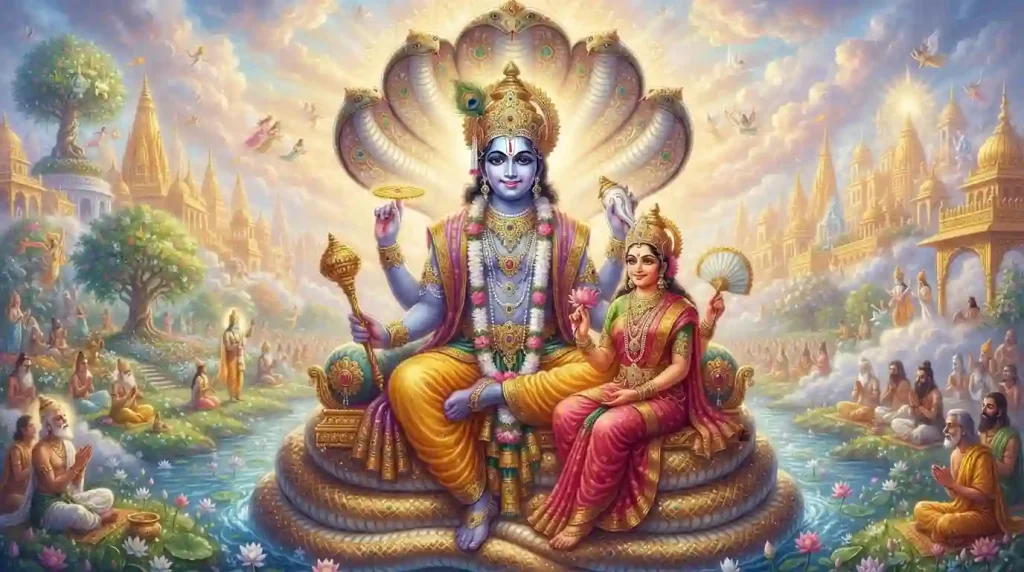
Vishnu is typically depicted with four arms, each holding a distinct symbolic object, representing his complete control over the four aspects of existence: mind, intellect, ego, and the material world.
Sudarshan Chakra
The Sudarshan Chakra is a spinning discus weapon, symbolizing the mind and the cycle of time. It represents Vishnu’s power to cut through ignorance and protect dharma swiftly and decisively.
Shankha (Conch Shell)
The conch shell represents the primordial sound of creation (linked to the sacred sound Om) and is associated with victory, as it was traditionally blown to signal the start of battle and the triumph of righteousness.
Lotus (Padma)
The lotus symbolizes purity, spiritual growth, and the unfolding of consciousness — rising clean and beautiful from muddy water, much like the soul rising above worldly attachment.
Kaustubha
The Kaustubha is a divine gem worn by Vishnu, said to have emerged during the churning of the cosmic ocean (Samudra Manthan), symbolizing consciousness and radiant purity.
Lakshmi
Vishnu’s eternal consort is Lakshmi, the goddess of wealth, prosperity, and abundance. Her presence beside Vishnu illustrates that true preservation includes material and spiritual well-being together.
Vaikuntha
Vishnu’s celestial abode is called Vaikuntha, described in the Puranas as a realm of eternal peace, beauty, and liberation, where devotees who attain moksha (liberation) may ultimately reside.
Dashavatara
One of the most beloved aspects of Vishnu worship is the Dashavatara, or ten principal avatars, through which Vishnu is believed to have descended to Earth to restore balance:
- Matsya — the fish
- Kurma — the tortoise
- Varaha — the boar
- Narasimha — the half-man, half-lion
- Vamana — the dwarf
- Parashurama — the warrior sage
- Rama — the ideal king, hero of the Ramayana
- Krishna — the divine statesman and teacher of the Bhagavad Gita
- Buddha — in many traditions, regarded as an avatar promoting compassion and non-violence (this varies by region and text)
- Kalki — the prophesied future avatar who will appear at the end of the current age (Kali Yuga) to restore dharma
Famous Vishnu Temples
- Tirumala Venkateswara Temple, Andhra Pradesh — one of the most visited religious sites in the world
- Jagannath Temple, Puri, Odisha
- Guruvayur Temple, Kerala
- Badrinath Temple, Uttarakhand
- Ranganathaswamy Temple, Srirangam, Tamil Nadu
Lord Shiva: The Destroyer & Transformer
Meaning
Shiva is known as Mahadev (“the Great God”) and represents the power of transformation, dissolution, and spiritual liberation. Far from being a symbol of negativity, Shiva’s destructive role is regarded in Hindu philosophy as essential and compassionate — clearing away what no longer serves growth, whether that is an old universe or an individual’s outdated attachments.
Why Destruction Is Necessary
In Hindu cosmology, nothing that has served its purpose is meant to remain forever. Just as a forest needs fire to clear old growth before new life can flourish, the universe needs periodic dissolution (pralaya) so that a fresh cycle of creation can begin. Shiva’s destruction is therefore better understood as transformation — an act of renewal rather than annihilation.
Trishul
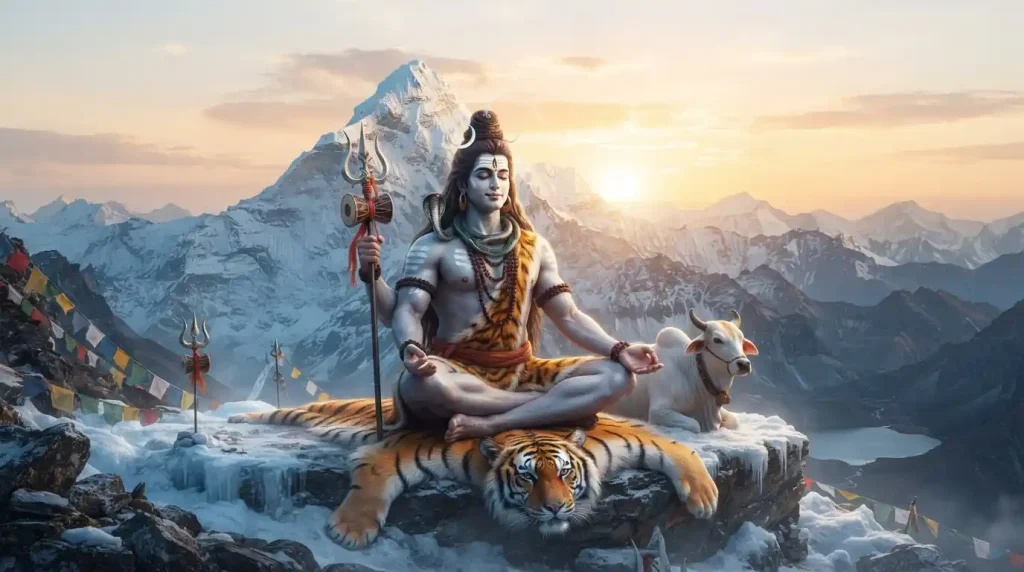
Shiva’s trident (Trishul) represents the three fundamental powers: creation, preservation, and destruction, all held within Shiva himself. It also symbolizes control over the three gunas (qualities of nature): sattva, rajas, and tamas.
Damru
The small hourglass-shaped drum, or Damru, is said to represent the primal sound of creation — the rhythmic beat from which the universe itself emerged, connecting Shiva to the origin of language, sound, and cosmic vibration.
Third Eye
Shiva’s third eye, located on his forehead, represents higher wisdom and spiritual insight beyond ordinary sight. When opened in anger, tradition holds it can reduce anything to ash — symbolizing the power of awakened consciousness to destroy ignorance and illusion.
Crescent Moon
The crescent moon on Shiva’s head symbolizes the cyclical nature of time and the balance between opposites — light and dark, growth and decline — while also representing his mastery over time itself.
River Ganga
The river Ganga flowing from Shiva’s matted hair represents his role in gently controlling and channeling powerful, potentially destructive forces (in this case, the descent of the sacred river) so that they benefit rather than devastate the world.
Snake Around Neck
The serpent coiled around Shiva’s neck represents his mastery over fear, ego, and death itself — he remains fearless and unshaken even in the presence of what most beings dread.
Nandi
Nandi, the bull, is Shiva’s loyal vehicle and is often seen seated facing the sanctum in Shiva temples, symbolizing devotion, strength, and unwavering focus.
Kailash
Mount Kailash in the Himalayas is regarded as Shiva’s abode — a place of stillness, meditation, and cosmic solitude, matching Shiva’s identity as the ultimate ascetic and yogi.
Parvati
Shiva’s consort is Parvati, representing divine feminine energy (Shakti). Their union symbolizes the balance between consciousness (Shiva) and dynamic energy (Shakti) — neither complete without the other.
Ganas
Shiva is accompanied by his Ganas, a host of semi-divine attendants, often depicted as playful, unconventional beings, symbolizing that divinity welcomes all, regardless of form or social status.
Jyotirlingas
The Jyotirlingas are twelve sacred shrines across India believed to be self-manifested forms of light representing Shiva, including Kashi Vishwanath (Varanasi), Somnath (Gujarat), Mahakaleshwar (Ujjain), and Kedarnath (Uttarakhand), among others. These sites remain among the most visited pilgrimage destinations in Hinduism.
How the Trimurti Works Together
The Cosmic Cycle
The three roles of the Trimurti are best understood not as isolated events but as one continuous, interlocking cycle:
- Creation (Brahma): A new universe, or cycle of existence, begins.
- Preservation (Vishnu): The universe is sustained, and dharma is protected across ages.
- Transformation (Shiva): The universe eventually dissolves, clearing the way for the next act of creation.
This cycle is not a one-time story from the ancient past — Hindu philosophy considers it an ongoing, eternal rhythm, playing out on cosmic, worldly, and even personal levels. Every beginning, every stable phase, and every ending in your own life can be seen as a small reflection of this same triadic pattern.
Stage | Deity | Everyday Reflection |
Creation | Brahma | Starting something new — a project, relationship, idea |
Preservation | Vishnu | Maintaining, nurturing, protecting what you’ve built |
Transformation | Shiva | Letting go, ending a chapter, making space for renewal |
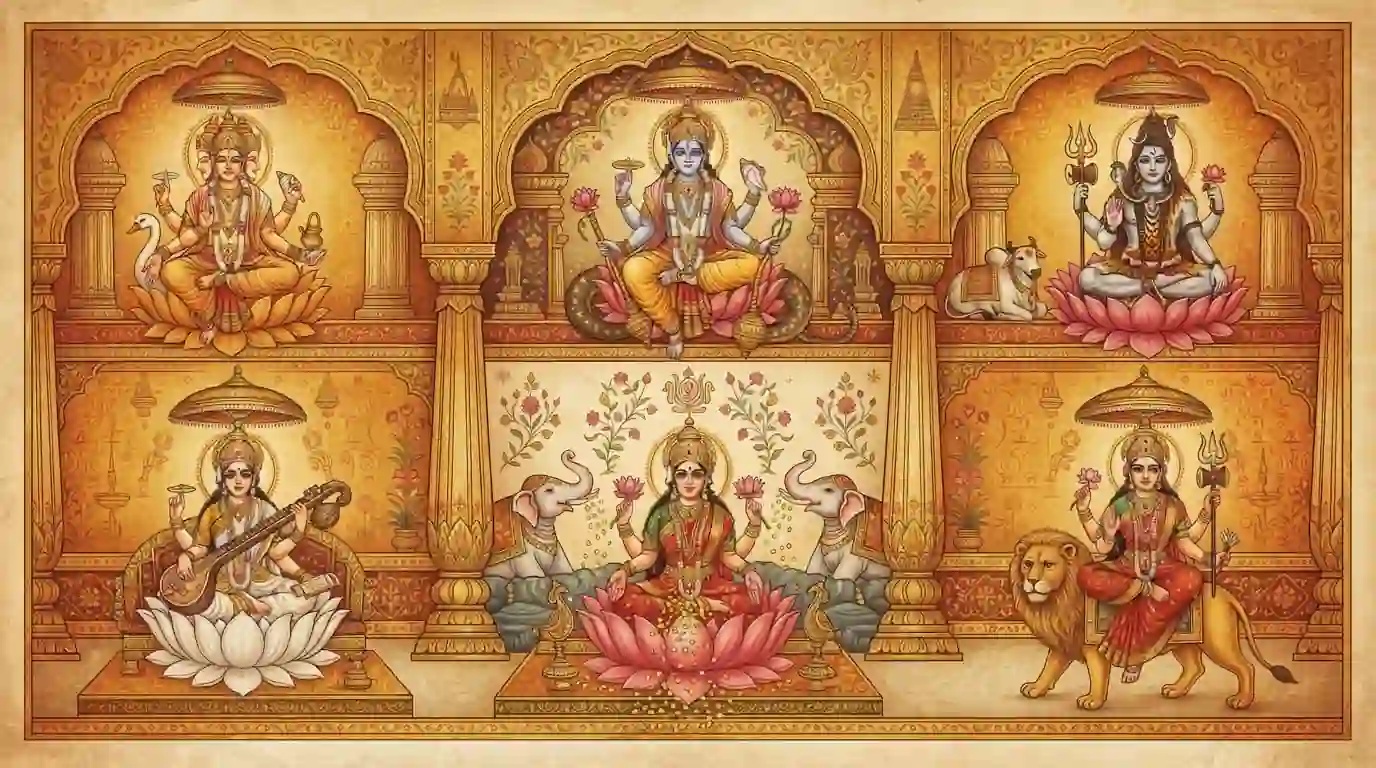
Connection with Tridevi
Just as the Trimurti represents three masculine cosmic functions, the Tridevi represents the three principal goddesses, each paired with a member of the Trimurti as the active energy (Shakti) that empowers them:
- Saraswati — consort of Brahma, goddess of knowledge and creativity
- Lakshmi — consort of Vishnu, goddess of wealth and preservation of abundance
- Parvati — consort of Shiva, goddess of power, devotion, and transformation
In Shakta traditions, which regard the Divine Feminine as the supreme source of all creation, it is Shakti — not the male deities alone — who provides the active energy without which Brahma, Vishnu, and Shiva could not perform their roles at all. This highlights an important point: Hindu theology contains multiple, equally valid ways of understanding ultimate divinity, depending on the tradition.
Trimurti in Different Scriptures
Scripture | What It Says About the Trimurti |
Rigveda | Does not present a formal Trimurti; contains early hymns about cosmic order, sacrifice, and a wide array of Vedic deities that later traditions built upon. |
Upanishads | Emphasizes Brahman, the formless absolute reality, laying philosophical groundwork for later unity-in-diversity concepts like the Trimurti. |
Mahabharata | Contains references to Brahma, Vishnu, and Shiva performing distinct cosmic roles, alongside the Bhagavad Gita’s teachings on Vishnu’s avatars maintaining dharma. |
Ramayana | Portrays Vishnu’s avatar Rama as the central hero, with Brahma and Shiva appearing in supporting roles, granting boons and blessings. |
Shiva Purana | Presents Shiva as the supreme reality, with Brahma and Vishnu described as manifesting from or being guided by him. |
Vishnu Purana | Presents Vishnu as the supreme preserver and ultimate reality, describing Brahma’s creation emerging from Vishnu. |
Bhagavata Purana | Focuses heavily on Vishnu’s avatars, especially Krishna, as central to cosmic preservation. |
Linga Purana | Centers on Shiva as the formless, ultimate source, symbolized through the Lingam. |
Skanda Purana | One of the largest Puranas, containing extensive mythology involving all three deities and their families. |
Expert Insight: Because Hinduism is not centrally codified by a single authority, different scriptures naturally emphasize different members of the Trimurti as supreme. This isn’t a contradiction — it reflects the diversity of devotional paths (Vaishnavism, Shaivism, and others) within the broader tradition of Sanatan Dharma.
The Trimurti in Hindu Temples
While individual temples to Vishnu and Shiva are extremely common across India, temples depicting all three members of the Trimurti together are comparatively rare and often architecturally significant:
- The Elephanta Caves near Mumbai house the famous Trimurti Sadashiva sculpture — a colossal three-faced bust often interpreted as representing Shiva’s creative, preservative, and destructive aspects combined.
- Certain temple complexes feature a shared shrine or sculptural panel showing Brahma, Vishnu, and Shiva together, symbolizing their unity, though each retains a dedicated primary shrine elsewhere in the same complex.
This relative rarity of joint Trimurti temples, compared to countless standalone Vishnu and Shiva temples, is itself a reflection of how Indian devotional practice has historically leaned toward worshipping one supreme form (whether Vishnu, Shiva, or Devi) as the ultimate reality, while still honoring the Trimurti concept philosophically.
Scientific, Psychological & Spiritual Interpretations
Scientific Interpretation
Some modern commentators draw a loose parallel between the Trimurti’s cycle of creation, preservation, and destruction and scientific concepts like the birth, life, and eventual death of stars, or the ongoing cycle of matter and energy in the universe. It’s worth being clear that this is a philosophical and poetic parallel, not a scientific claim made by the scriptures themselves, which speak in the language of cosmology and metaphysics rather than empirical physics.
Psychological Interpretation
Psychologically, the Trimurti can be read as a map of the human mind and life cycle:
- Brahma — the creative, generative impulse (new ideas, ambitions, beginnings)
- Vishnu — the stabilizing force (habits, routines, relationships that sustain us)
- Shiva — the necessary letting go (releasing old patterns, fears, or identities that no longer serve growth)
Spiritual Interpretation
Spiritually, the Trimurti reflects the inner journey of a devotee: creating positive intentions (Brahma), sustaining spiritual discipline (Vishnu), and ultimately dissolving the ego to reach liberation, or moksha (Shiva). In this reading, the entire Trimurti exists not just “out there” in the cosmos, but within every seeker’s own path.
Symbolism of the Number Three
The number three recurs throughout Hindu philosophy far beyond the Trimurti itself:
- The three gunas — sattva (balance), rajas (activity), tamas (inertia)
- The three worlds — Swarga (heaven), Prithvi (earth), Patala (netherworld)
- The three states of consciousness — waking, dreaming, deep sleep
- The three main paths to liberation — Jnana Yoga (knowledge), Bhakti Yoga (devotion), Karma Yoga (action)
This recurring pattern suggests that the number three carries deep structural significance in Hindu thought — representing balance, completeness, and the natural rhythm of beginning, middle, and end found throughout existence.
Common Misconceptions
- “The Trimurti means Hinduism has only three gods.” In reality, Hinduism recognizes a vast pantheon of deities, many of which are understood as expressions of the same underlying divine reality. The Trimurti specifically represents three cosmic functions, not a limit on the number of gods.
- “Shiva is a god of evil or death worship.” Shiva’s association with destruction refers to the transformation and dissolution necessary for renewal, not malevolence.
- “Brahma is unimportant or a lesser god.” Brahma’s creative role is foundational; he is simply worshipped less frequently due to specific mythological and philosophical reasons discussed earlier.
- “All Hindus worship the Trimurti equally.” In practice, most devotees are devoted primarily to one deity — often Vishnu, Shiva, or a form of the Goddess — as their personal supreme deity (Ishta Devata), while still respecting the broader Trimurti framework.
Difference Between Trimurti and Trinity
Readers unfamiliar with Hindu philosophy sometimes compare the Trimurti to the Christian Holy Trinity, but the concepts differ in important ways:
Aspect | Trimurti (Hinduism) | Trinity (Christianity) |
Composition | Three separate deities (Brahma, Vishnu, Shiva) representing three cosmic functions | One God existing as three persons (Father, Son, Holy Spirit) |
Roles | Distinct cosmic functions: creation, preservation, destruction | Not functionally divided; each person is understood as fully God |
Worship pattern | Individual deities are worshipped separately, often with one as personally supreme | Worshipped as a single unified God |
Philosophical basis | Rooted in cyclical time and multiple valid devotional paths | Rooted in a single doctrinal formulation of monotheism |
This comparison is useful for context, but it’s best understood as an analogy rather than a direct equivalence, since the underlying theology of each tradition developed independently and rests on different philosophical foundations.
Frequently Asked Questions
Who are the Trimurti in Hinduism?
The Trimurti are Brahma (the Creator), Vishnu (the Preserver), and Shiva (the Destroyer/Transformer) — the three deities associated with the universe’s essential cosmic functions.
What does the word Trimurti mean?
Trimurti means “three forms,” from the Sanskrit words tri (three) and murti (form), referring to three manifestations of one supreme reality.
Why is Brahma rarely worshipped compared to Vishnu and Shiva?
Various Puranic legends describe curses placed on Brahma, and philosophically his creative task is considered already accomplished, leading devotees to focus worship on Vishnu and Shiva instead.
Is Brahma the same as Brahman?
No. Brahma is a personal deity, the Creator within the Trimurti, while Brahman refers to the formless, infinite, ultimate reality described in the Upanishads from which all gods, including Brahma, are said to emerge.
Why does Vishnu have four arms?
Vishnu’s four arms represent his mastery over the mind, intellect, ego, and material world, each symbolized by an object he holds: the discus, conch, mace, and lotus.
What are Vishnu's ten avatars called?
They are collectively called the Dashavatara, including Matsya, Kurma, Varaha, Narasimha, Vamana, Parashurama, Rama, Krishna, Buddha, and Kalki.
Why is Shiva called Mahadev?
Mahadev means “Great God,” a title reflecting Shiva’s supreme status among ascetics and his role as the ultimate source of transformation and liberation in Shaivism.
What does Shiva's third eye represent?
It represents higher spiritual wisdom and the power to destroy ignorance and illusion.
Are Brahma, Vishnu, and Shiva equal in power?
Philosophically, they are considered equal expressions of one ultimate reality, though different scriptures and devotional traditions (Vaishnavism, Shaivism) may present one as supreme over the others.
What is the Tridevi?
The Tridevi is the female counterpart to the Trimurti, consisting of Saraswati, Lakshmi, and Parvati — the divine consorts and energies (Shakti) of Brahma, Vishnu, and Shiva.
Is the Trimurti mentioned in the Rigveda?
Not as a formal triad. The Rigveda contains the philosophical seeds of later Trimurti concepts, but the formal grouping develops more clearly in the epics and Puranas.
What is the difference between Shiva and Vishnu?
Vishnu is primarily associated with preservation, order, and periodic incarnation to restore dharma, while Shiva is associated with transformation, asceticism, and cosmic dissolution.
Why does Shiva live on Mount Kailash?
Mount Kailash symbolizes stillness, solitude, and the meditative, ascetic nature central to Shiva’s identity as the supreme yogi.
Interesting Facts
- The Elephanta Caves Trimurti sculpture is over 20 feet tall and is considered one of the finest examples of ancient Indian rock-cut art.
- The Pushkar Brahma Temple in Rajasthan remains one of the only major temples in India dedicated primarily to Brahma.
- There are twelve Jyotirlingas spread across India, each considered a self-manifested form of Shiva.
- Vishnu’s avatar Krishna delivers the Bhagavad Gita, one of the most studied philosophical texts in the world, on the battlefield of Kurukshetra.
- The concept of cyclical time in Hindu cosmology involves units so vast — like the Kalpa, spanning billions of years — that they parallel modern scientific timescales for the age of the universe, though the two frameworks are not derived from the same methodology.
Conclusion
The Trimurti — Brahma, Vishnu, and Shiva — offers one of Hinduism’s most profound answers to the mystery of existence: that creation, preservation, and transformation are not separate, competing forces, but three faces of a single, continuous rhythm running through the cosmos, through history, and through each of our own lives. Whether you feel drawn to Brahma’s creative spark, Vishnu’s steady protection, or Shiva’s fearless transformation, understanding the Trimurti offers a richer lens through which to see not just Hindu philosophy, but the natural cycles of beginnings, middles, and endings that shape everything around us.
What’s your favorite member of the Trimurti, and why? Share your thoughts in the comments below, and don’t forget to share this article with someone curious about Hindu philosophy.
Explore More on MythologyMantra.com
- Brahma: The Creator of the Universe
- Lord Vishnu’s 10 Avatars Explained
- Why Lord Shiva Is Called Mahadev
- The Tridevi Explained
- The Meaning of Om in Hinduism