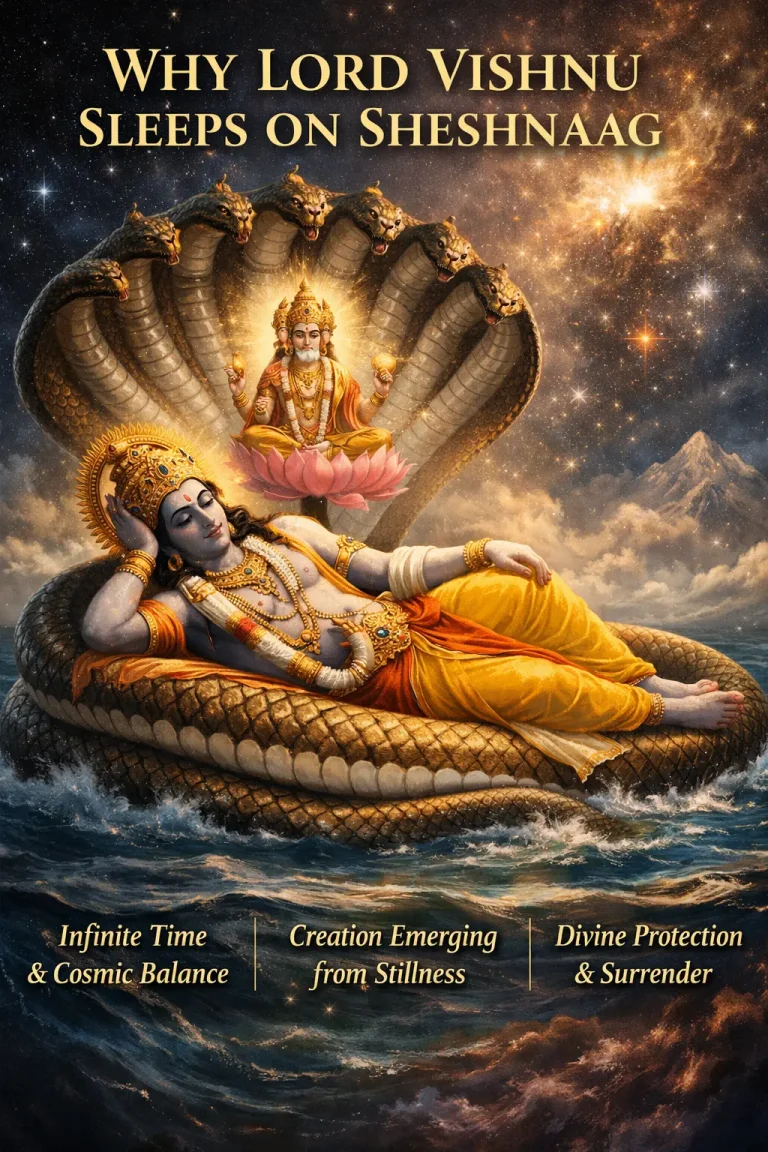
One of the most captivating and symbolic images in Hindu mythology is that of Lord Vishnu reclining on the cosmic serpent Sheshnaag, floating peacefully on the infinite ocean of milk (Kshira Sagar). This divine posture, known as Anantashayana or Yoga Nidra, is not merely artistic or mythological—it carries deep philosophical, spiritual, and cosmic meaning.
Why does the Preserver of the Universe choose to sleep?
Why on a serpent?
And what does this imagery teach humanity about time, creation, and balance?
This blog explores why Lord Vishnu sleeps on Sheshnaag, uncovering its symbolism, scriptural references, and spiritual lessons. Through this we can deeply understand the Hindu Mythology
Who Is Lord Vishnu? The Preserver of the Universe
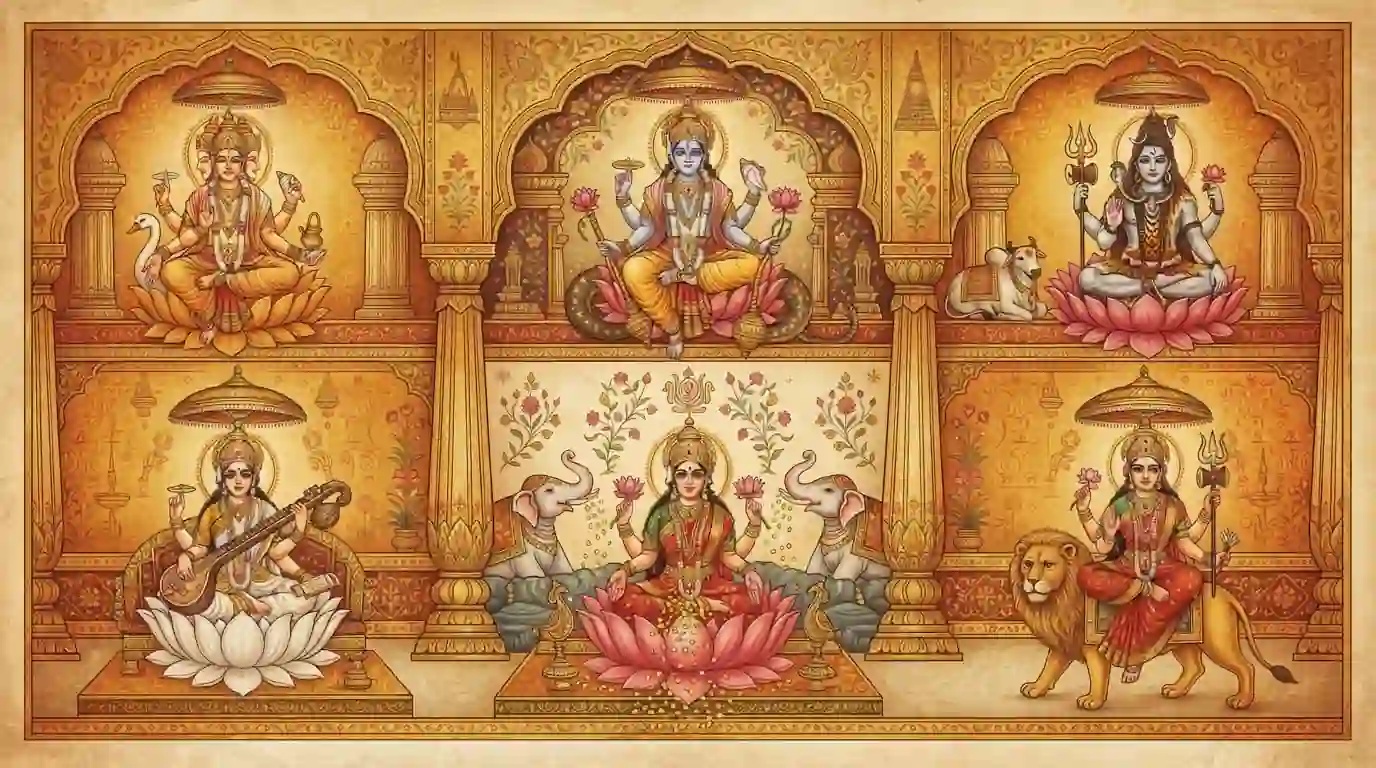
In Hinduism, Lord Vishnu is part of the Trimurti:
Brahma – the Creator
Vishnu – the Preserver
Shiva – the Destroyer and Transformer
Vishnu’s role is to maintain cosmic order (Dharma). Whenever chaos overtakes righteousness, Vishnu incarnates on Earth as avatars like Rama, Krishna, and Narasimha to restore balance.
Yet, between cycles of creation, Vishnu is described as resting in a transcendental state—this is where the image of Vishnu sleeping on Sheshnaag becomes essential.
Who Is Sheshnaag? The Cosmic Serpent
Sheshnaag, also known as Ananta, means the Endless One.
Key attributes of Sheshnaag:
King of all serpents
Symbol of infinity, time, and eternity
Eternal servant and devotee of Lord Vishnu
Supports all planets on his many hoods
In scriptures, Sheshnaag is not a fearful creature but a divine cosmic force representing stability and continuity of the universe.

The Scene of Vishnu Sleeping on Sheshnaag
Lord Vishnu reclines on the coiled body of Sheshnaag, whose multiple hoods form a protective canopy over Vishnu’s head. Beneath them lies the cosmic ocean, symbolizing infinite potential and unmanifested reality.
From Vishnu’s navel emerges a lotus, upon which Lord Brahma is seated, beginning the act of creation.
This image is loaded with symbolism, each element conveying profound cosmic truths.
Why Does Lord Vishnu Sleep? The Concept of Yoga Nidra
Vishnu’s sleep is not ordinary sleep. It is called Yoga Nidra, or cosmic sleep.
Meaning of Yoga Nidra:
A state between consciousness and unconsciousness
Deep meditation, not inactivity
Awareness without action
During this state:
The universe dissolves (Pralaya)
Creation pauses
Time rests within Vishnu
Vishnu sleeps so that creation may begin again.
Why Vishnu Sleeps on Sheshnaag: Deep Symbolism Explained
1. Sheshnaag Represents Infinite Time
Sheshnaag (Ananta) symbolizes endless time. Vishnu resting on him signifies that time itself is under divine control.
➡️ Message: The universe exists within time, and time exists within Vishnu.
2. Serpent Symbolizes Cosmic Energy (Kundalini)
In yogic philosophy, the serpent represents Kundalini Shakti, the dormant spiritual energy within all beings.
➡️ Vishnu resting on a serpent shows:
Perfect balance of energy
Supreme mastery over cosmic forces
3. Balance Between Chaos and Order
The cosmic ocean represents chaos and potential, while Sheshnaag represents structure and stability.
Vishnu resting between them signifies:
Harmony between chaos and order
Preservation amid uncertainty
4. Absolute Surrender of Devotion
Sheshnaag serves Vishnu eternally, acting as:
His bed
His shelter
His throne
➡️ This shows the ideal relationship between devotee and God—complete surrender without ego.
5. Creation Emerges from Stillness
From Vishnu’s stillness arises Brahma, the creator.
➡️ Spiritual lesson:
All creation begins in silence. Stillness is the womb of creativity.
Scriptural References
Bhagavata Purana
Describes Vishnu reclining on Sheshnaag during the dissolution of the universe.
Vishnu Purana
Explains the role of Ananta as the foundation of all worlds.
Mahabharata
Mentions Sheshnaag as an incarnation of Balarama, the elder brother of Krishna.
Scientific & Philosophical Interpretations
Interestingly, modern thinkers draw parallels between this imagery and science:
Cosmic ocean → Quantum field / vacuum energy
Serpent coils → Spiral galaxies & DNA structures
Cosmic sleep → Periods of cosmic contraction
This shows how ancient symbolism anticipated deep universal truths.
Spiritual Lessons for Humanity
1. Rest Is Not Weakness
Even the Preserver rests. True power knows when to pause.
2. Surrender Leads to Stability
Like Sheshnaag, surrender to higher truth brings purpose.
3. Stillness Creates Transformation
Silence and meditation lead to creation and clarity.
Why Is Vishnu Shown Sleeping While Shiva Meditates?
This contrast teaches balance:
Vishnu maintains the universe through Yoga Nidra
Shiva dissolves illusions through Tapasya (meditation)
Both represent different paths to the same cosmic truth.
Temples Depicting Vishnu on Sheshnaag
Some famous temples include:
Padmanabhaswamy Temple, Kerala
Ranganathaswamy Temple, Srirangam
Anantashayana Temple, Karnataka
These temples emphasize Vishnu’s reclining form, symbolizing protection and cosmic peace.
The image of Lord Vishnu sleeping on Sheshnaag is not about rest—it is about cosmic balance, infinite time, divine control, and the rhythm of creation and dissolution.
It teaches us that:
Stillness is powerful
Time is sacred
Surrender is strength
Creation begins in silence
In a restless world, Vishnu’s serene posture reminds humanity to find peace within chaos and trust the divine rhythm of existence.