

For centuries, Hindu mythology has celebrated the mighty Trimurti – Brahma (the Creator), Vishnu (the Preserver) and Shiva (the Destroyer) – as the cosmic architects of the universe. But behind every great god stands his divine Shakti (energy), and together they form the mysterious Tridev and Tridevi.This little-known story reveals how the Tridevi—Saraswati, Lakshmi, and Parvati—serve a vital function in sustaining the universal cycle of creation, preservation, and transformation. We’ll also unveil powerful Tridevi mantras whose sacred syllables are believed to unlock wisdom, wealth and strength.
The Trinity of Power: Meet Brahma, Vishnu & Shiva
The Tridev, also known as the Trimurti, are Hinduism’s three main gods, each representing a key aspect of the universe. Brahma is the Creator of all, Vishnu is the Preserver who maintains cosmic balance, and Shiva is the Destroyer and Transformer who removes the old to make way for renewal. Their combined efforts maintain cosmic harmony: without any one of them, the cycle of life could not continue. The sacred sound “Om” symbolizes the Trimurti, with “A” representing Brahma’s creation, “U” for Vishnu’s preservation, and “M” for Shiva’s power of transformation. Together, these three gods energize the entire universe.
The Divine Consorts: The Tridevi Goddesses
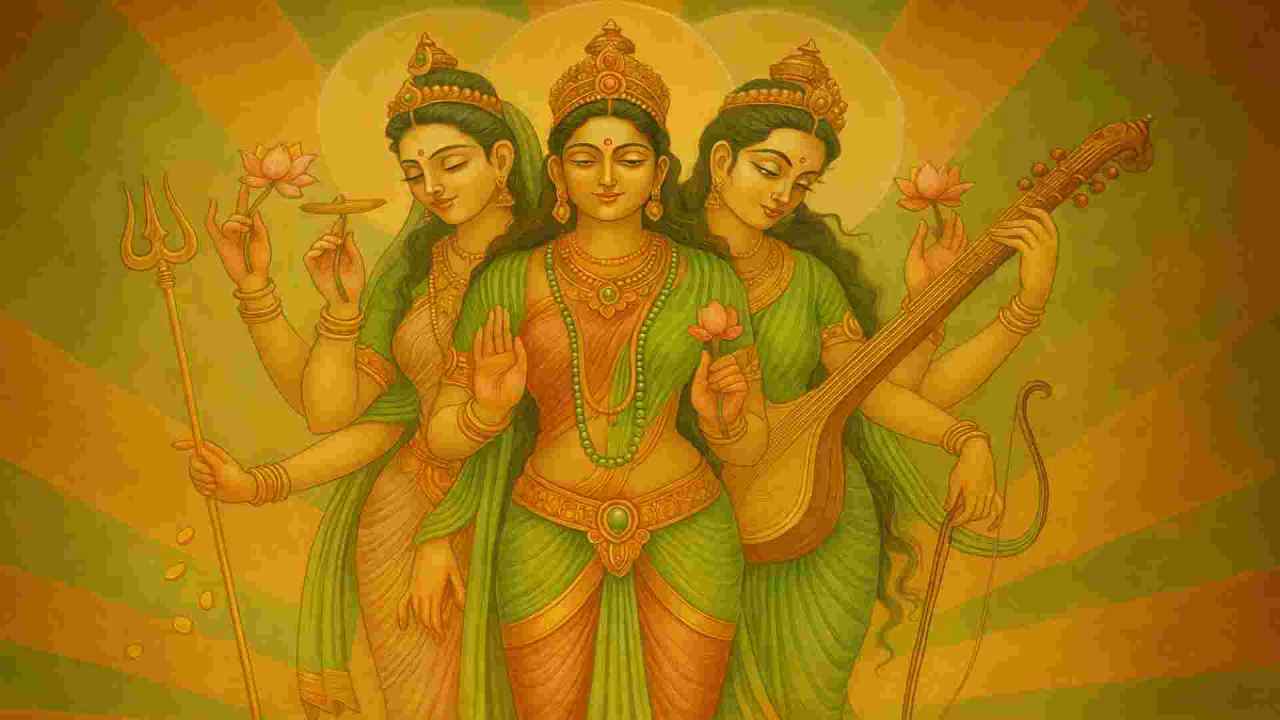
Each deity of the Tridev has a divine partner who represents the feminine energy, or Shakti, essential for channeling his power.The Tridevi consists of the three principal goddesses: Saraswati, Lakshmi, and Parvati. They are much more than mere consorts—they are the fundamental creative energies that empower Brahma, Vishnu, and Shiva to carry out their cosmic roles. In many traditions, all three are ultimately forms of the Great Goddess (Adī Śakti) in her various aspects. In practical terms, the Tridevi grant wisdom, wealth, and energy, enabling the gods to carry out their cosmic duties.
Each Tridevi is worshipped in her own right. Saraswati teaches humans how to create, Lakshmi sustains with abundance, and Parvati transforms through might. Legend even says the Trimurti could not function without their consorts – the goddess Lakshmi, for instance, powers all of Vishnu’s divine deeds. In one hymn the sage-say “That alone, Pāramesvarī of three attributes, creates the universe; she alone sustains it and she alone destroys it at the proper time”. In short, the Tridevi are the hidden Shakti—the divine energy, behind every god.
Saraswati represents wisdom, education, music, and the inspiration behind all artistic pursuits. She is usually portrayed holding a veena, carrying a sacred book, and riding either a swan or a peacock.Saraswati gives the intelligence and creativity that make creation possible. As Brahma’s partner, she is the source of his creative energy—the divine mind behind the material world.
The Times of India states that ‘Saraswati, together with Lakshmi and Parvati, is one of the three principal goddesses of Hinduism… collectively, they are known as the Tridevi.’ Students and artists honor Saraswati—particularly during the Basant Panchami festival—seeking her blessings for wisdom and creative inspiration. In short, whenever knowledge blooms or music flows, Saraswati is the hand at work.
Lakshmi, often called Sri, is worshipped as the goddess of wealth, prosperity, beauty, and good fortune. She is usually pictured standing on a lotus flower, showering coins from her hands, with an elephant or two blessing her.Lakshmi is Vishnu’s consort and the divine energy that empowers him to maintain the universe. In myths she emerged during the cosmic ocean-churning, and her blessings flow into places where righteousness and devotion dwell. In the literal sense she brings material wealth and comfort, but she also symbolizes spiritual abundance – health, happiness and goodwill.
Astrologer AstroTalk states, ‘Lakshmi is the honored consort of Lord Vishnu, embodying wealth, prosperity, beauty, power, and fertility.’ Along with Parvati and Saraswati, she forms the Tridevi, the three key goddesses.’ During Diwali and Dhanteras, devotees traditionally chant her mantras and display her icons at home to welcome her blessings. In the words of Times of India: believers “chant Lakshmi mantras… to invoke the Goddess Lakshmi and receive her divine blessings” on the festival.
Parvati is the powerful consort of Shiva and the living embodiment of Shakti, the ultimate divine energy. Born to the mountain king, Parvati is the gentle mother goddess of love and devotion—but her soft name hides her immense strength. When needed, Parvati transforms into fierce warrior forms (Durga, Kali, Mahishasuramardini, etc.) to vanquish demons. She is called Gauri (pure one), Shakti, Lalita, and in her supreme form Tripura Sundari, among many other names. One name, Narayani, literally means “the feminine avatar of Narayana (Vishnu)”, reflecting her status as the supreme divine mother.
Indeed, hymns like Ya Devi Sarva Bhuteshu and Sharanye Gauri Narayani Namostute invoke her as the all-pervading mother goddess. In mythology, every strength of Shiva (even his daughter Durga in the Mahabharata) ultimately comes from Parvati. No wonder Shakta tradition teaches that Mahadevi (Great Goddess) created Brahma, Vishnu and Shiva themselves. Parvati is not merely Shiva’s partner; she serves as the essential energy that fuels the universe’s ongoing process of transformation.
Tridevi Mantras: Chanting the Cosmic Shakti
One of the strongest ways devotees connect with the Tridevi is by chanting mantras—sacred sounds charged with divine feminine energy. Each consort has famous chants invoking her unique power. Here are examples of Tridevi mantras and their meanings:
- Saraswati Mantra: ‘Om Aim Saraswatyai Namah’ – meaning, “Om, I bow to Goddess Saraswati, the giver of wisdom.” This eight-syllable mantra honors her as the divine source of knowledge. Chanting it is said to enhance concentration, creativity and learning ability.
- Lakshmi Mantra: ‘Om Shreem Mahalakshmiyei Namah’ – which means, “Om, I bow to the supreme Goddess Lakshmi.” This beeja (seed) mantra is chanted to attract wealth, prosperity, and fortune. Times of India notes that Diwali prayers often use this mantra to invite the goddess’s blessings.
- Parvati (Durga) Mantra: “Om Sarva Mangala Mangalye…Sharanye Triyambake Gauri Narayani Namostute” – meaning “Salutations to the auspicious one, O Gauri (Parvati), who brings all welfare… Divine Mother Narayani, we bow to you!”. This ancient hymn honors Parvati (in her forms as Durga or Gauri) as the embodiment of all blessings and the supreme protector. Reciting it calls forth her cosmic energy and compassion.
Each of these mantras works at an energetic level. Repeating Om Aim Saraswatyai Namah can clear the mind and invite Saraswati’s grace, while Om Shreem Mahalakshmiyei Namah is said to pulse with Lakshmi’s abundance. The Parvati hymn Sharanye Gauri Narayani… thrums with protective Shakti. Devotees often chant them daily or during special rituals to harmonize with the goddess energy. As one spiritual text explains, these chants “connect you to the higher realm and Universe… purify your soul… [and] awaken the spiritual energy within you”.
Why the Tridev and Tridevi Matter Today
For devotees, the Tridev and Tridevi are more than mythological figures—they are vibrant, living energies. Shiva, Vishnu and Brahma represent the blueprint of the universe’s cycles, while Saraswati, Lakshmi and Parvati embody the energies required to make those cycles possible. In modern life, their legends translate to very practical spiritual tools: Saraswati’s energy helps students and artists, Lakshmi’s attracts prosperity (or at least a spirit of abundance), and Parvati’s gives courage to face challenges. Moreover, the mantras preserve ancient wisdom in sound form.
In this untold story of Tridev and Tridevi, we see a complete system: creators that couldn’t create without intelligence; preserver that couldn’t sustain without wealth; destroyer who couldn’t transform without power. The consorts, far from being passive, are the catalysts of every divine act. By chanting their mantras or reflecting on their names, devotees say they tap into those same cosmic principles.
Whether you approach it as metaphor or faith, the Tridev and Tridevi dynamic teaches balance. Creation (Brahma with Saraswati) requires wisdom and creativity; preservation (Vishnu with Lakshmi) depends on generosity and compassion; destruction (Shiva with Parvati) calls for strength and surrender. Discovering the “secret” of these divine pairs—such as through the Om Namo Narayani chant—is regarded by many as a pathway to balance and success.
Ultimately, the tale of the Tridev and Tridevi shows that every mighty force has a feminine counterpart, and together the Tridev and Tridevi sustain a complete, harmonious cycle. These timeless myths inspire countless devotees, who chant the mantras and honor the names of the Tridev and Tridevi to connect with their divine energy. At its heart, the untold story reveals that the goddesses are the unsung well-springs of creation, preservation, and transformation—a truth celebrated in verses and mantras through the ages.