

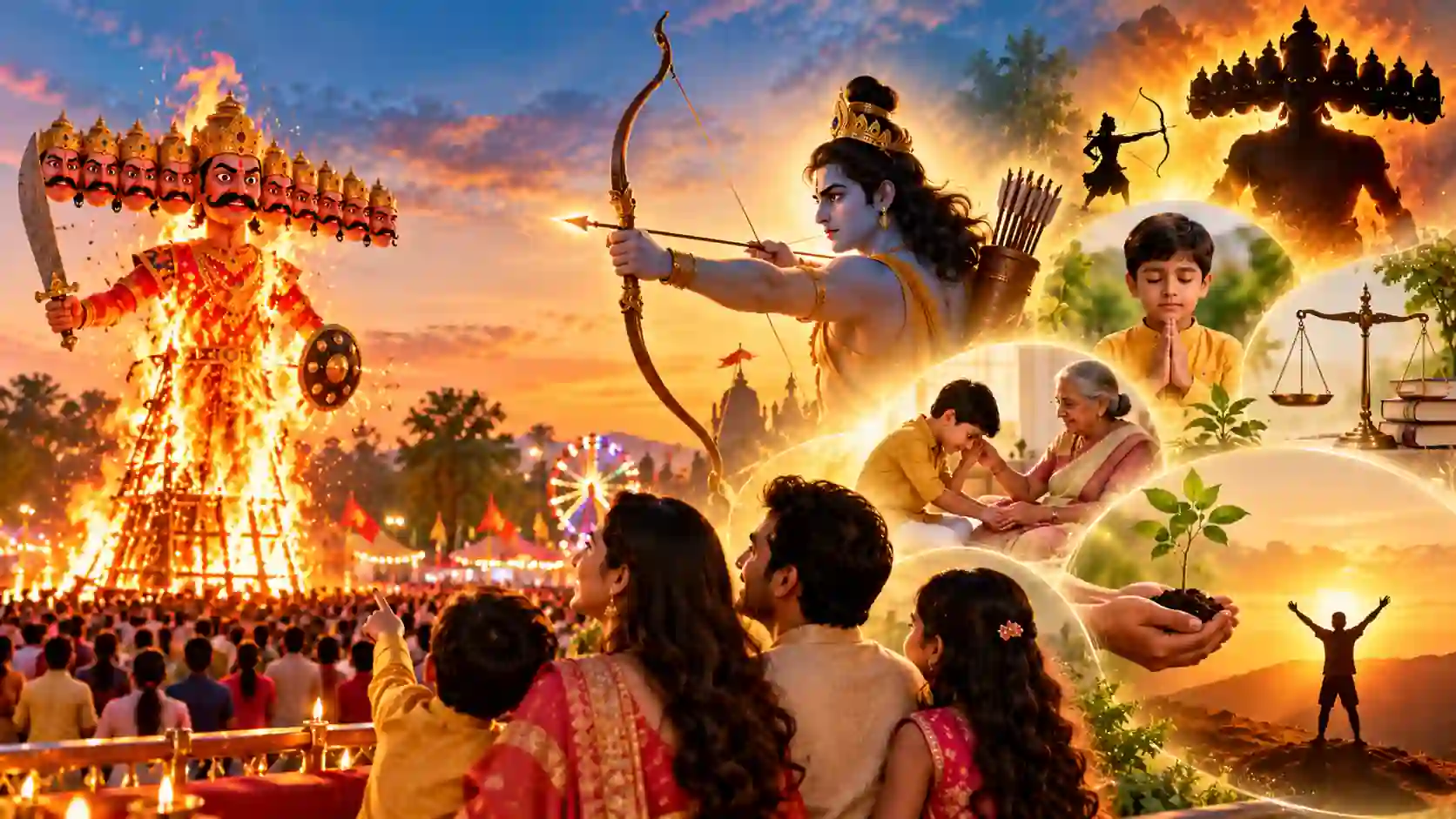
Ask most people what Dussehra is about and they’ll describe a burning effigy. But the meaning of Dussehra is much wider than Ravan Dahan. On Tuesday, 20 October 2026, millions of Indians will mark Vijayadashami without lighting any effigy at all: by immersing the Goddess’s image in Bengal, by carrying deities to Dhalpur in Kullu, by writing a child’s first letters in Kerala, or by worshipping their tools in Tamil Nadu. Some communities even honour Ravana. Here is the fuller picture.
It’s Also the Goddess’s Victory
Vijayadashami is the tenth day after the nine nights of Navratri, and in Shakta traditions it celebrates the Goddess Durga’s victory over Mahishasura, as told in the Devi Mahatmya. In Bengal, Odisha, Assam and Tripura, it’s the day of Durga visarjan, when the image of the Goddess is bid farewell after Durga Puja. The Bengali Krittivasi Ramayana even links the two stories, describing Rama’s worship of the Goddess before his final battle. Read our Navratri 2026 guide for the nine nights that lead here.
It’s a Mahabharata Day Too
Tradition connects Dussehra to the Pandavas. During their final year of exile, spent in disguise, they hid their weapons in a Shami tree; when the year ended, they retrieved them. That’s why the Shami tree is worshipped on Dussehra and its leaves, along with those of the Apta tree, are exchanged as “gold” in Maharashtra and Karnataka. The festival therefore draws on both great epics, not one.
It’s About Work, Learning and New Beginnings
In South India, the last days of Navratri and Vijayadashami bring Ayudha Puja, when tools, vehicles and books are honoured, and Vidyarambham, when young children are formally introduced to letters. Across India, the day is considered auspicious for starting new ventures. See our pieces on Ayudha Pooja and Vidyarambham.
Regional Dussehras Without a Bonfire
Mysuru, Karnataka
The Jamboo Savari carries Goddess Chamundeshwari through the city on an elephant. See our Mysore Dasara guide.
Kullu, Himachal Pradesh
The festival begins on Vijayadashami and runs for a week, as village deities gather to honour Raghunath ji.
Bastar, Chhattisgarh
A long, many-week festival honouring the goddess Danteshwari, with its own chariot procession.
Kolkata, West Bengal
Sindoor Khela and immersion processions close Durga Puja, which UNESCO recognised as Intangible Cultural Heritage in 2021.
Where Ravana Is Remembered Differently
Ravana is not only a villain in Indian memory. The Ramayana itself presents him as learned, powerful and deeply devoted to Shiva, and tradition credits him with the Shiva Tandava Stotram. Some local traditions go further. In Bisrakh in Uttar Pradesh, residents associate their village with Ravana’s birth; in Mandsaur in Madhya Pradesh, local custom regards Ravana as a son-in-law through Mandodari and treats him with respect; and in parts of Kanpur, a temple dedicated to Ravana is reported to open for worship on Dussehra. These are local beliefs rather than mainstream practice, but they show how layered the story is. Our articles on Ravana as villain and devotee and the rise and fall of Ravana explore this further.
So What Is Ravan Dahan Really About?
Seen in this wider context, burning Ravana’s effigy is less about hating a character and more about what he represents when talent is ruled by pride. A popular interpretation reads his ten heads as ten human failings, from anger and greed to arrogance and jealousy. The fire is a public way of saying: let these go. That message holds whether you watch a towering effigy in Delhi or simply sit quietly at home with a lamp. For more on the effigy itself, read Effigies vs fireworks.
Frequently Asked Questions
Is Ravana burned everywhere in India on Dussehra?
No. Ravan Dahan is mainly a North and Central Indian tradition. Mysuru, Kullu, Bastar, Bengal and much of South India celebrate Vijayadashami in other ways.
What else is celebrated on Vijayadashami?
The Goddess Durga’s victory over Mahishasura, Shami puja linked to the Pandavas, Ayudha Puja, Vidyarambham and, in Bengal, Durga visarjan.
Are there places where Ravana is worshipped?
Yes, a few local traditions, such as in Bisrakh (Uttar Pradesh) and Mandsaur (Madhya Pradesh), remember Ravana with respect. These are local customs rather than widespread practice.
When is Dussehra 2026?
Tuesday, 20 October 2026. See our Dussehra 2026 guide for muhurat timings.
The Meaning of Dussehra: One Festival, Many Victories
Dussehra holds the Goddess’s triumph, Rama’s war, the Pandavas’ return, the honour of work and learning, and a dozen regional celebrations, all on the same day. The burning effigy is just the most visible part. This year, try to notice the rest. For the bigger picture, read why Dussehra matters more than you think.