


The Navratri 2026 dates are Sunday, 11 October to Monday, 19 October for the nine nights, with Vijayadashami (Dussehra) on Tuesday, 20 October. That calendar has real consequences for planning. Ghatasthapana lands on a Sunday morning, Saptami and Ashtami fall on the following weekend, Navami is a Monday, and Dussehra is a Tuesday. Below is the day-wise calendar, followed by what each of these dates means for puja timing, fasting, Garba nights, travel and work.
Navratri 2026 Day-Wise Calendar
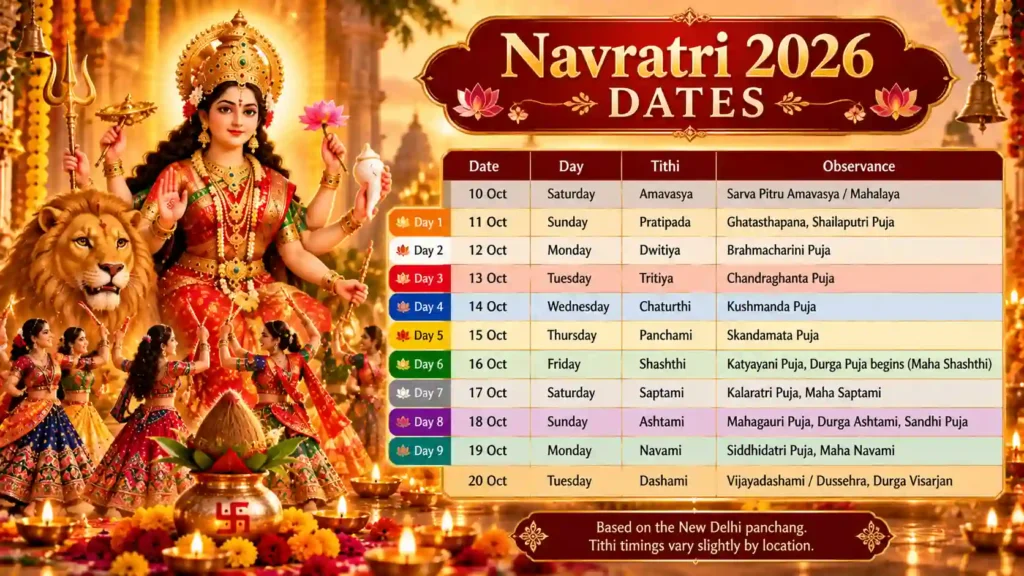
| Date | Day | Tithi | Observance |
|---|---|---|---|
| 10 Oct | Saturday | Amavasya | Sarva Pitru Amavasya / Mahalaya |
| 11 Oct | Sunday | Pratipada | Ghatasthapana, Shailaputri Puja |
| 12 Oct | Monday | Dwitiya | Brahmacharini Puja |
| 13 Oct | Tuesday | Tritiya | Chandraghanta Puja |
| 14 Oct | Wednesday | Chaturthi | Kushmanda Puja |
| 15 Oct | Thursday | Panchami | Skandamata Puja |
| 16 Oct | Friday | Shashthi | Katyayani Puja, Durga Puja begins (Maha Shashthi) |
| 17 Oct | Saturday | Saptami | Kalaratri Puja, Maha Saptami |
| 18 Oct | Sunday | Ashtami | Mahagauri Puja, Durga Ashtami, Sandhi Puja |
| 19 Oct | Monday | Navami | Siddhidatri Puja, Maha Navami |
| 20 Oct | Tuesday | Dashami | Vijayadashami / Dussehra, Durga Visarjan |
A Sunday Ghatasthapana Makes Day One Easier
For New Delhi, Pratipada begins at 9:19 PM on Saturday, 10 October and ends at 9:30 PM on Sunday, 11 October. The Ghatasthapana muhurat is 6:19 AM to 10:12 AM on Sunday, with the Abhijit Muhurat (11:44 AM–12:31 PM) as a fallback. Because it’s a Sunday, most families won’t have to squeeze the ritual in before office or school. Use Saturday evening to set up the altar so Sunday morning is calm.
The day before, 10 October, is Sarva Pitru Amavasya, the final day of Pitru Paksha, and is also observed as Mahalaya in Bengal. Many families complete their ancestral rites that day and then turn to Navratri preparations in the evening, so plan shopping for samagri earlier in the week.
Five Working Days in the Middle
Days two to six (12–16 October) fall on Monday to Friday. If you’re fasting and attending Garba, this stretch is where fatigue builds. Keep weekday puja short, prepare vrat food in batches, and choose two or three Garba nights rather than all five. For practical fasting tips, see why fasting on Navratri is harder than you think.
The Big Weekend: Saptami and Ashtami
Maha Saptami on Saturday, 17 October and Durga Ashtami on Sunday, 18 October form the heart of the festival for many families, and this year they land on a weekend. That’s good news for Kanya Pujan, for the Ashtami fast, and for pandal-hopping in Kolkata and other Durga Puja centres. It also means bigger crowds everywhere. If you are visiting a well-known Durga Puja pandal or a major Shakti temple, consider going on Shashthi (Friday, 16 October) or early on Saturday morning.
Sandhi Puja, performed at the junction of Ashtami and Navami, depends on exact tithi timings for your city, so check a local panchang for the precise window.
Navami on Monday, Dussehra on Tuesday
Maha Navami falls on Monday, 19 October. Families who do Kanya Pujan on Navami rather than Ashtami will need to plan around school and work, so a morning slot is usually best. Vijayadashami on Tuesday, 20 October is typically a public holiday in most states, but check your state or employer’s holiday list, since Navami and Dashami holidays vary by region. Many people take Monday off to create a four-day stretch from Saturday to Tuesday.
What the Dates Mean for Travel
The Saturday-to-Tuesday window is likely to be the busiest travel period of the festival, especially to Kolkata, Gujarat, Mysuru and popular Devi shrines. Book trains and stays early. If you’re visiting Mysuru for Dasara, read our guide to Mysore Dasara, and for a regional overview see Navratri Celebrations Across India.
Less Than Three Weeks to Diwali
Diwali falls on Sunday, 8 November 2026, just 19 days after Dussehra. If you’re cleaning and decorating for Navratri, it’s worth doing a deeper clean now and keeping torans, lamps and fabrics for Diwali. Budget-wise, the two festivals will feel like a single season this year.
Frequently Asked Questions
What are the Navratri 2026 start and end dates?
Navratri 2026 starts on Sunday, 11 October and the nine nights end on Monday, 19 October (Maha Navami). Vijayadashami follows on Tuesday, 20 October.
When is Durga Ashtami in 2026?
Durga Ashtami is on Sunday, 18 October 2026.
When is Dussehra 2026?
Dussehra (Vijayadashami) is on Tuesday, 20 October 2026. Read more on our Dussehra festival page.
Do Navratri dates differ by city?
The dates are generally the same across India in 2026, but exact tithi start and end times, the Ghatasthapana muhurat and the Sandhi Puja window vary by location. Always check a local panchang such as DrikPanchang.
Plan Around the Calendar
A Sunday start and a weekend Ashtami make Navratri 2026 friendlier than most years for working families, as long as the five weekdays in between are planned with care. For the nine goddesses, colours and rituals, see our Navratri 2026 celebration guide, and for a step-by-step checklist, read how to plan Navratri without the stress.