

Goddess Saraswati: The Emergence of Divine Intelligence
In the vast tapestry of Hindu mythology, few deities embody the essence of knowledge and creativity as profoundly as Goddess Saraswati.
She is not a warrior, nor a ruler of realms; she is the goddess of wisdom, music, speech, and learning. Her birth marks the emergence of refined thought, artistic expression, and intellectual clarity. Saraswati is the force that transforms chaos into understanding, sound into meaning, and silence into song.
Origins in the Vedas
Goddess Saraswati first appears in the Rigveda, not as a goddess, but as a river. The Saraswati River is described as mighty, nourishing, and life-giving. It flows between the realms of the physical and the spiritual, connecting earth and heaven.
Over time, the river becomes personified as a deity, one who embodies the flow of knowledge, the clarity of speech, and the purity of thought. Her transformation from river to goddess reflects the evolution of human consciousness.
The Symbolism of the River
The river Saraswati is more than a geographical feature; it is a metaphor for the flow of wisdom. Just as water nourishes life, knowledge nourishes the soul.
The river’s disappearance from the physical landscape is mirrored by the subtle nature of true wisdom; it is not always visible, but always present. Goddess Saraswati’s association with the river emphasizes movement, continuity, and depth.
Saraswati's Iconography
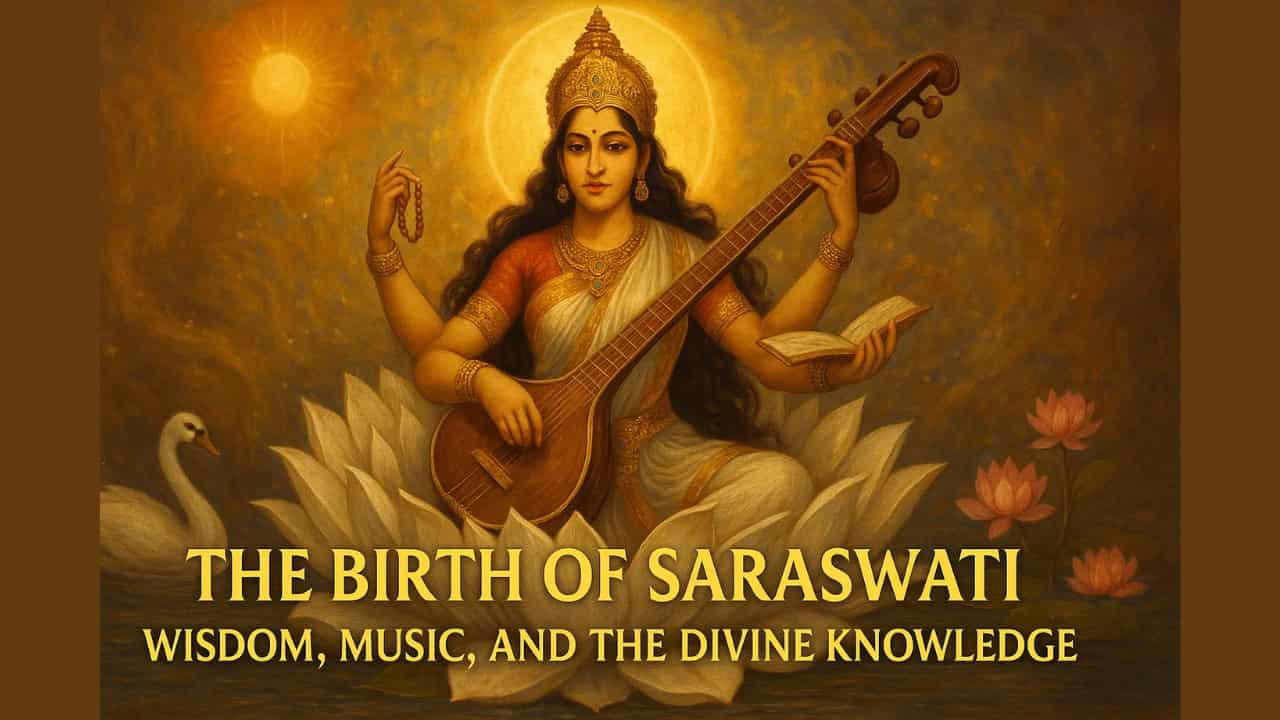
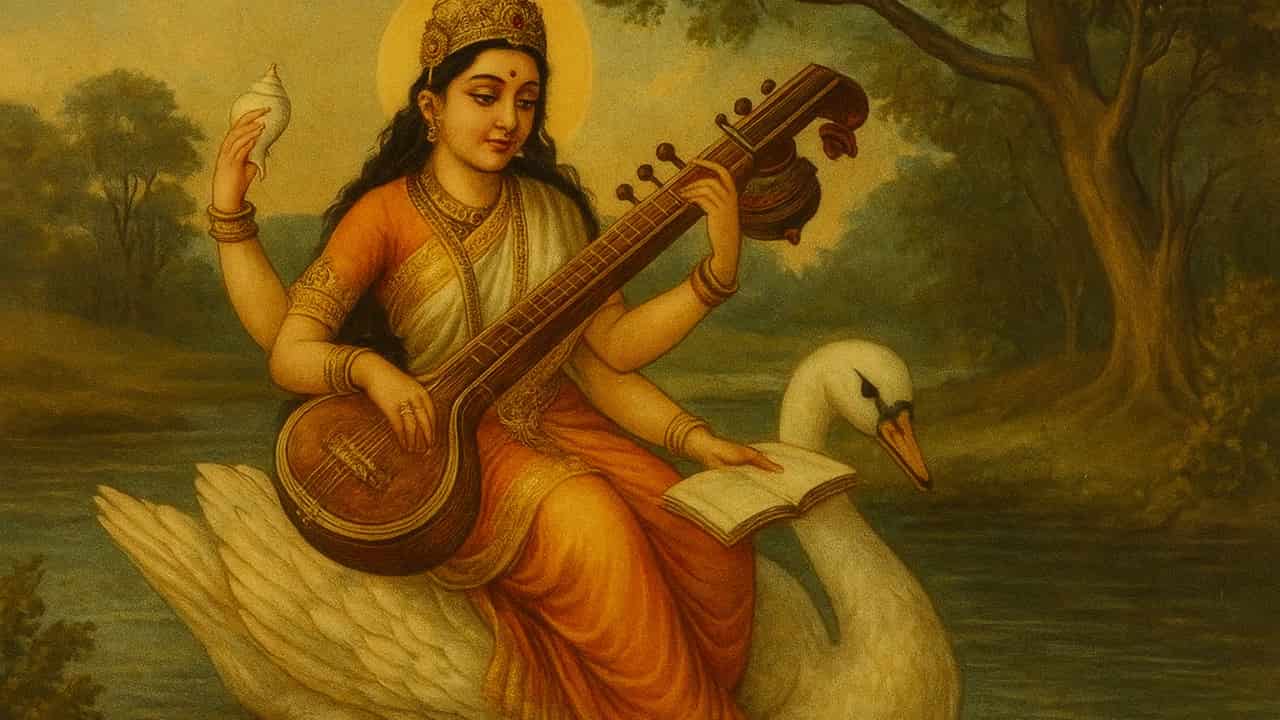
Goddess Saraswati is depicted as serene and graceful. She wears white garments, symbolizing purity and clarity. She sits on a white lotus, representing enlightenment. In her hands, she holds a veena (a stringed instrument), a book, a rosary, and sometimes a pot of water. Each item reflects a facet of her domain:
- The veena signifies music and rhythm.
- The book represents learning and scripture.
- The rosary symbolizes meditation and spiritual focus.
- The pot of water denotes the flow of wisdom and purification.
Goddess Saraswati and Lord Brahma
In some myths, Saraswati is born from the mind of Brahma, the creator. She emerges when Brahma realizes that creation requires not just form, but understanding. Without knowledge, the universe would be inert. Goddess Saraswati becomes his consort, guiding him in the act of creation. She gives structure to thought, order to speech, and meaning to existence.
The Power of Vak: Divine Speech
Saraswati is closely associated with Vak, the goddess of speech. In Vedic philosophy, speech is not merely communication; it is creation. The universe itself is said to have emerged from sound. Saraswati governs this sacred speech, ensuring that words carry truth, clarity, and purpose. She is invoked by poets, scholars, and musicians alike.
Saraswati in the Upanishads
In the Upanishads, Saraswati is not just a deity; she is a principle. She represents Jnana (knowledge), Vidya (learning), and Buddhi (intellect). She is the inner light that guides seekers toward self-realization.
Her presence is subtle, often experienced as insight, inspiration, or clarity. She is the whisper behind understanding, the silence before revelation.
The Festival of Vasant Panchami
Saraswati is celebrated during Vasant Panchami, a festival that marks the arrival of spring and the renewal of learning. On this day, students place their books before her, musicians tune their instruments, and devotees wear yellow, the color of wisdom and energy.
Schools and colleges hold special prayers, and children are often taught their first letters. The festival is not just religious; it is cultural, educational, and deeply personal.
Rituals and Offerings
During Saraswati Puja, devotees offer white flowers, fruits, and sweets. The rituals are simple, emphasizing purity and sincerity. The focus is on invoking clarity, removing ignorance, and seeking guidance. Many choose to begin new studies or creative projects on this day, believing Saraswati’s blessings will ensure success and insight.
Saraswati in Classical Arts
Goddess Saraswati is the patron of the classical arts, music, dance, literature, and philosophy. She is invoked before performances, her name chanted in rehearsals, her image placed in studios. Artists see her not just as a muse, but as a guide. Her presence is felt in the rhythm of a raga, the grace of a mudra, the depth of a verse.
Goddess Saraswati and Education
In Indian tradition, Saraswati is the goddess of education. Schools, universities, and libraries often have her image. Students pray to her before exams, teachers invoke her before lectures. She represents not just academic success, but intellectual integrity. Her blessings are sought for understanding, not just memorization, for wisdom, not just information.
The Role of Saraswati in Modern India
In modern India, Saraswati remains deeply revered. Her image is found in classrooms, her name invoked in ceremonies, her ideals embedded in cultural values. She represents the aspiration for learning, the respect for teachers, and the pursuit of truth.
In a rapidly changing world, Saraswati offers a reminder that wisdom is eternal and that knowledge must be guided by ethics.
Saraswati and the Mind
Goddess Saraswati governs the mind, its clarity, focus, and creativity. She is the force behind inspiration, the spark behind innovation. In meditation, she is visualized as a radiant presence in the forehead, illuminating thought and guiding insight. Her energy is subtle, often felt as intuition, clarity, or a sudden understanding.
Saraswati and the Flow of Time
Just as a river flows through landscapes, Saraswati flows through time. She connects ancient chants with modern science, classical music with contemporary thought. Her presence is not confined to temples; it is found in classrooms, studios, libraries, and laboratories. She is the timeless current of learning that adapts, evolves, and endures.
Goddess Saraswati and the Feminine Principle
Saraswati embodies the feminine principle of wisdom, gentle, nurturing, yet powerful. She is not aggressive, but assertive. She does not conquer, but enlightens. Her energy is graceful, her influence profound. In a world that often values noise over nuance, Saraswati reminds us of the strength of subtlety.
Saraswati and the Quest for Truth
The pursuit of truth is Saraswati’s path. She does not offer easy answers; she invites inquiry. She encourages questioning, exploration, and reflection. Her devotees are seekers, not followers. She values curiosity over certainty, depth over surface, and understanding over opinion.
Saraswati and the Responsibility of Knowledge
With knowledge comes responsibility. Saraswati teaches that learning must serve truth, compassion, and justice. She warns against arrogance, misuse, and superficiality. Her blessings are not for those who seek power through knowledge, but for those who seek wisdom through humility.
Final Reflections
Goddess Saraswati is not just a goddess; she is a principle, a presence, a path. She flows through rivers, thoughts, melodies, and minds. She connects the ancient with the modern, the spoken with the silent, the known with the unknown.
To honor Saraswati is to honor the pursuit of wisdom, the beauty of learning, and the grace of understanding. In her presence, knowledge becomes sacred, and learning becomes a lifelong journey.