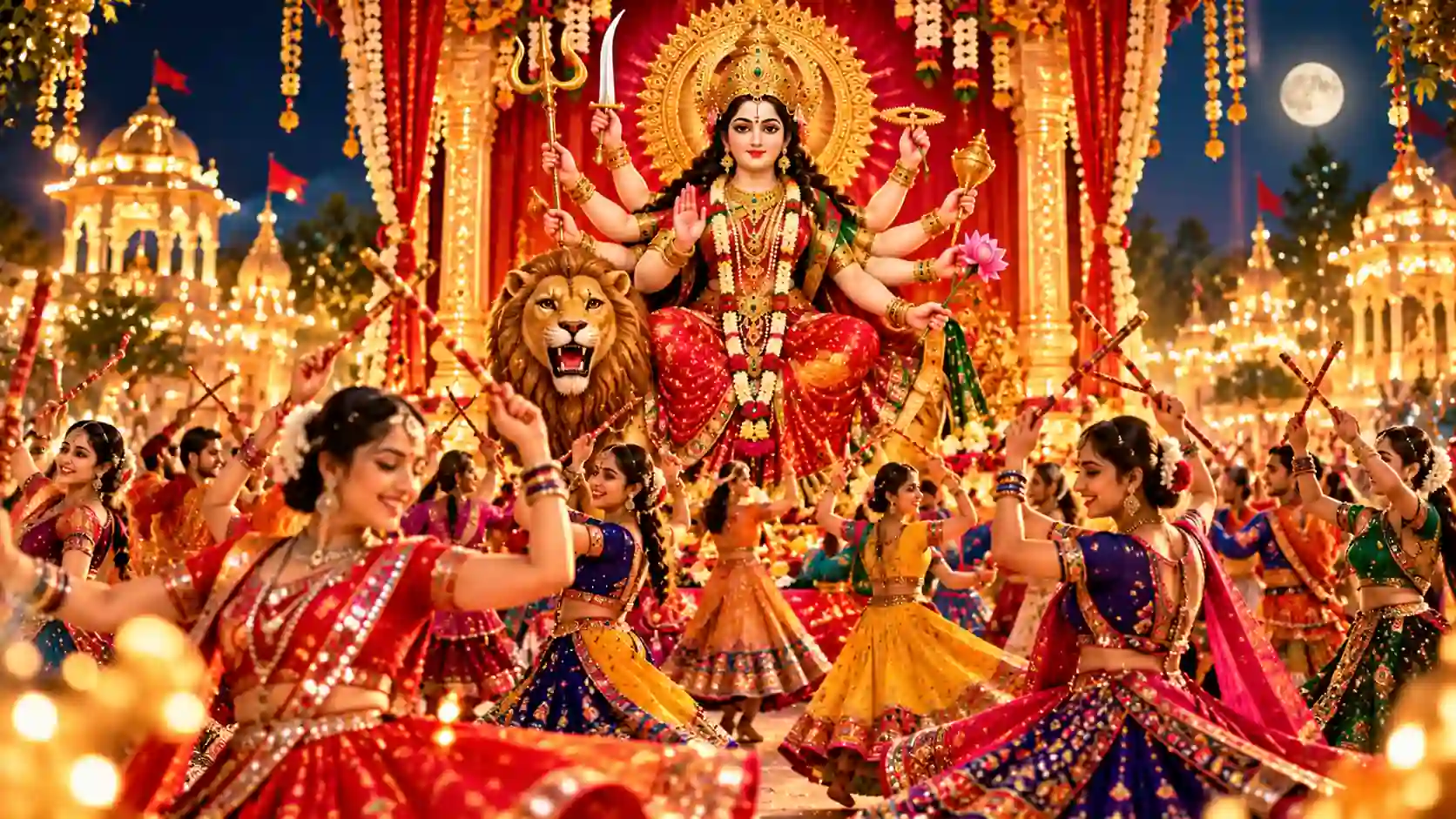
Navratri 2026 begins on Sunday, 11 October with Ghatasthapana and ends with Vijayadashami (Dussehra) on Tuesday, 20 October. Over these nine nights, devotees worship the nine forms of Goddess Durga, known together as the Navadurga, through fasting, daily puja, recitation of the Devi Mahatmya and, in many parts of India, Garba, Dandiya and Durga Puja celebrations.
This guide brings everything together in one place: the dates, the Ghatasthapana muhurat, which goddess is worshipped on which day, the popular colour sequence, and practical ways to observe the festival at home, whether you keep a full nine-day fast or simply light a lamp each evening.
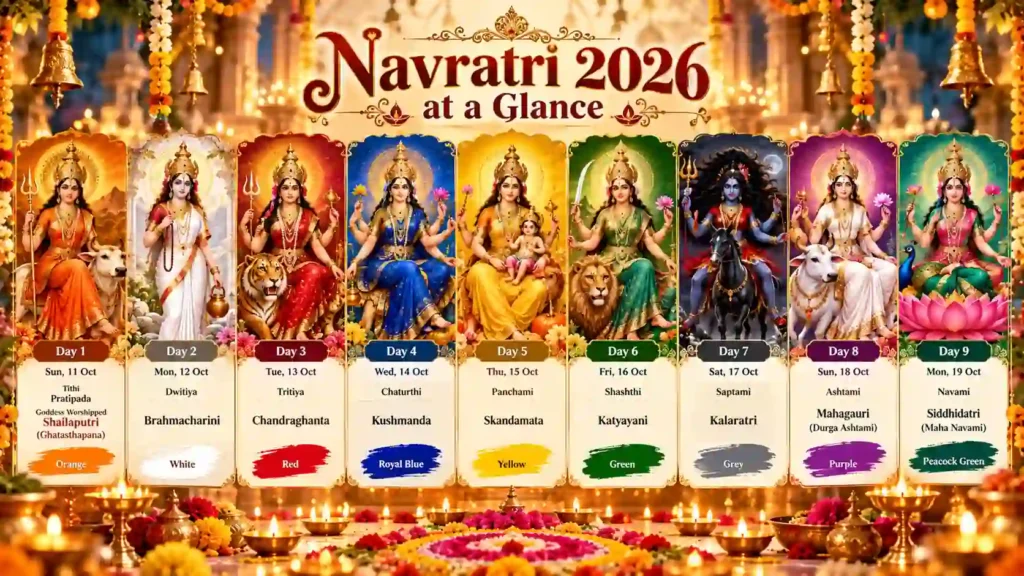
Navratri 2026 at a Glance
The autumn festival is called Shardiya Navratri (or Sharad Navratri) because it falls in the Sharad season, during the bright fortnight (Shukla Paksha) of the month of Ashwin. It is the most widely celebrated of the Navratris observed through the year; the other well-known one is Chaitra Navratri in spring.
| Day | Date | Tithi | Goddess Worshipped | Popular Colour |
|---|---|---|---|---|
| 1 | Sun, 11 Oct | Pratipada | Shailaputri (Ghatasthapana) | Orange |
| 2 | Mon, 12 Oct | Dwitiya | Brahmacharini | White |
| 3 | Tue, 13 Oct | Tritiya | Chandraghanta | Red |
| 4 | Wed, 14 Oct | Chaturthi | Kushmanda | Royal Blue |
| 5 | Thu, 15 Oct | Panchami | Skandamata | Yellow |
| 6 | Fri, 16 Oct | Shashthi | Katyayani | Green |
| 7 | Sat, 17 Oct | Saptami | Kalaratri | Grey |
| 8 | Sun, 18 Oct | Ashtami | Mahagauri (Durga Ashtami) | Purple |
| 9 | Mon, 19 Oct | Navami | Siddhidatri (Maha Navami) | Peacock Green |
| 10 | Tue, 20 Oct | Dashami | Vijayadashami / Dussehra | — |
Ghatasthapana Muhurat 2026
Ghatasthapana, also called Kalash Sthapana, is the ritual that formally opens Navratri. For New Delhi, the Pratipada tithi begins at 9:19 PM on 10 October and ends at 9:30 PM on 11 October. The recommended Ghatasthapana muhurat on Sunday, 11 October is 6:19 AM to 10:12 AM. If that window is missed, the Abhijit Muhurat from 11:44 AM to 12:31 PM is traditionally treated as an alternative.
Panchang makers generally advise performing Ghatasthapana in the first part of the day while Pratipada is running, and before midday. Timings differ by location, so devotees outside Delhi should check a local panchang such as DrikPanchang for their city.
Why Navratri Is Celebrated
The central story of Navratri comes from the Devi Mahatmya, a text that forms part of the Markandeya Purana and is also recited as the Durga Saptashati. It describes the Goddess as the combined power of the gods, who takes form to defeat Mahishasura and other demons that the gods themselves could not overcome. Vijayadashami, the “victorious tenth day”, marks that triumph.
In much of North India, the same period is also tied to the Ramayana. Ramlila performances run through the nine nights and end with the burning of Ravana’s effigy on Dussehra. These two narratives sit side by side comfortably in most households: the Goddess is worshipped during the nine nights, and Rama’s victory is remembered on the tenth day.
The Nine Forms of Durga (Navadurga)
Each day of Navratri is traditionally dedicated to one form of the Goddess. Shailaputri, the daughter of the mountain, opens the festival. Brahmacharini represents austerity and devotion, while Chandraghanta, with the crescent moon on her forehead, is associated with courage. Kushmanda is linked in tradition with the creation of the cosmos, and Skandamata is the mother of Skanda (Kartikeya).
The second half moves into fiercer and then more serene forms. Katyayani is the warrior goddess often linked to the slaying of Mahishasura, and Kalaratri is the dark, protective form who destroys fear. Mahagauri is worshipped on Ashtami as the radiant, purified form, and Siddhidatri, the giver of spiritual accomplishments, closes the cycle on Navami. You can read more about the Goddess herself on our Maa Durga page.
How to Celebrate Navratri 2026 at Home
Set up the kalash and akhand jyoti
On the first morning, a clean space is prepared for the Goddess. A kalash filled with water, topped with mango leaves and a coconut, is installed, and in many homes barley (jau) is sown in a tray of soil beside it. The sprouts that grow over nine days are seen as a sign of prosperity. Some families also keep an akhand jyoti, a lamp that is kept burning continuously through the festival. If you plan to do this, keep it in a safe, ventilated spot away from curtains and make sure someone is always at home.
Daily puja and recitation
A simple daily routine is enough: light a lamp and incense, offer flowers and fruit, and recite a prayer to the day’s goddess. Many devotees read a portion of the Durga Saptashati every day, while others recite the Durga Chalisa and perform an evening aarti. There is no single correct method; family tradition usually decides the details.
Fasting
Fasts range from a full nine-day vrat to fasting only on the first and last days, or on Ashtami alone. Most fasting households avoid grains, onion and garlic, and cook with kuttu (buckwheat) flour, singhara (water chestnut) flour, sabudana, samak rice, potatoes, fruit and dairy, using sendha namak (rock salt) instead of regular salt. Anyone who is pregnant, elderly, diabetic or on regular medication should speak with a doctor before fasting, and a lighter fast is a perfectly valid choice.
Kanya Pujan on Ashtami or Navami
In 2026, Durga Ashtami falls on Sunday, 18 October and Maha Navami on Monday, 19 October. On one of these days many families invite young girls home, wash their feet, apply tilak, and serve them halwa, puri and black chana before offering small gifts. The girls are honoured as forms of the Goddess. Whether a family does this on Ashtami or Navami depends on its own custom.
How India Celebrates Navratri
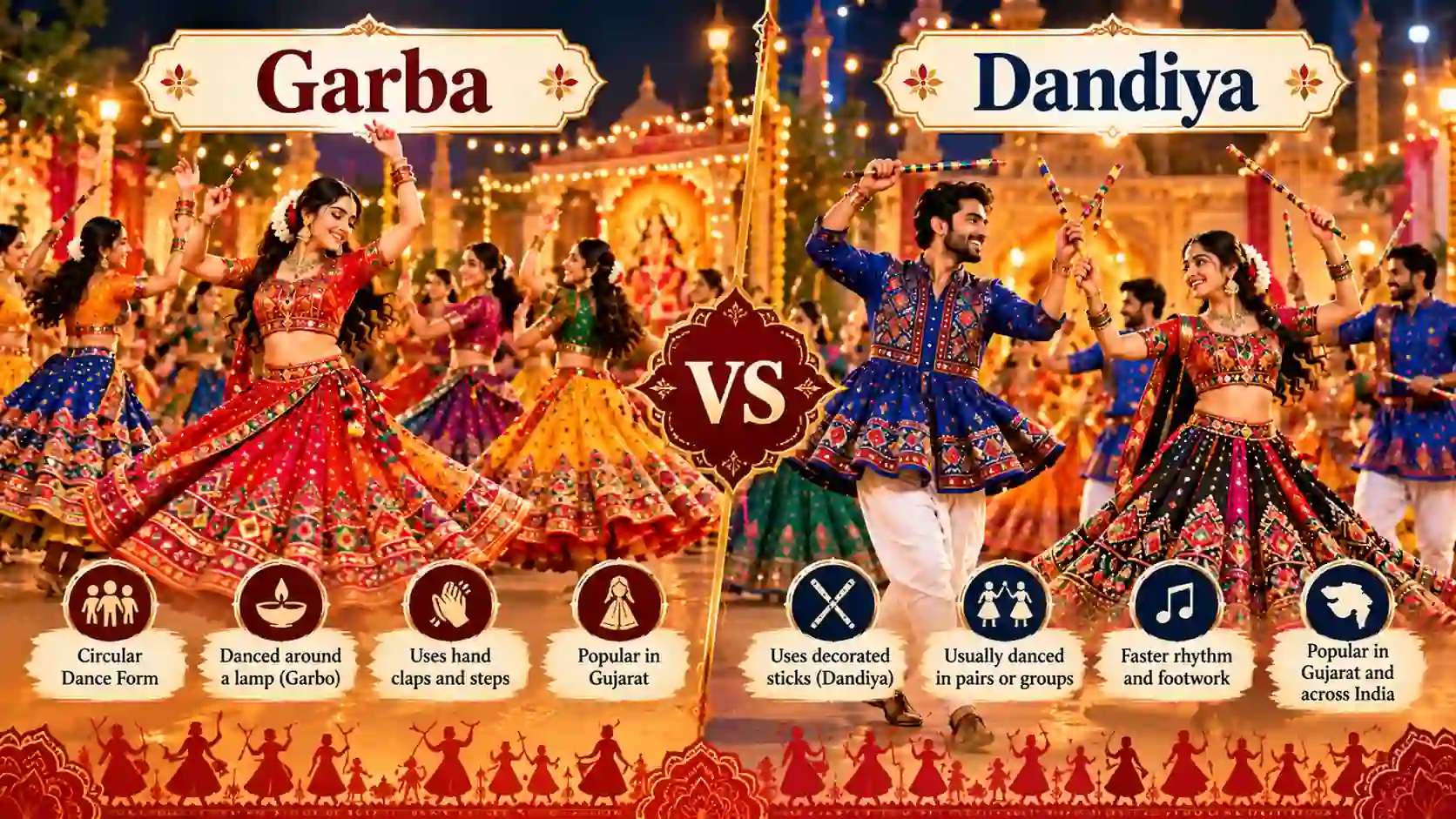
Navratri looks very different from one state to the next. Gujarat is known for nights of Garba and Dandiya Raas, and Garba of Gujarat was added to UNESCO’s list of Intangible Cultural Heritage in December 2023. In West Bengal, Odisha, Assam and Tripura, the last days of the festival are celebrated as Durga Puja, with Maha Shashthi on 16 October and immersion on Vijayadashami. In Tamil Nadu, Karnataka and Andhra Pradesh, many homes arrange a Golu or Bommai Kolu display of dolls, and in Kerala and parts of the South, Saraswati Puja and Ayudha Puja are central. Mysuru’s royal Dasara is among the best-known Vijayadashami celebrations in the country.
For a closer look at these regional traditions, see Navratri Celebrations Across India and Mysore Dasara.
Frequently Asked Questions
When does Navratri 2026 start and end?
Shardiya Navratri 2026 starts on Sunday, 11 October with Ghatasthapana. Maha Navami is on Monday, 19 October, and Vijayadashami (Dussehra) is on Tuesday, 20 October.
What is the Ghatasthapana time for Navratri 2026?
For New Delhi, the muhurat is 6:19 AM to 10:12 AM on 11 October, with the Abhijit Muhurat (11:44 AM to 12:31 PM) as an alternative. Check your local panchang, as times vary by city.
Is Durga Ashtami 2026 on 18 October?
Yes. Durga Ashtami, dedicated to Mahagauri, falls on Sunday, 18 October 2026. Sandhi Puja is performed at the junction of the Ashtami and Navami tithis, so its exact time depends on your location.
Do I have to wear the Navratri colour of the day?
No. The nine-colour sequence is a popular modern custom, especially in Maharashtra, and it changes each year based on the weekday the festival begins. It is not a scriptural requirement.
Can I celebrate Navratri without fasting?
Yes. Many devotees observe Navratri through daily prayer, reading the Durga Saptashati, lighting a lamp, or Kanya Pujan without keeping a fast. Health and personal circumstances matter more than the strictness of the vrat.
Before the First Lamp Is Lit
The best Navratri is one you can actually sustain for nine days. Decide in advance how you will fast, which days you will do Kanya Pujan, and where the kalash will sit, and the rest of the festival tends to fall into place. For the full festival profile, visit our Navratri festival page, and continue to Dussehra for the tenth day.