Any Pitru Paksha vs. Halloween comparison starts with the same unsettling idea: that the dead do not simply disappear, and that there are certain nights of the year when the distance between them and us gets thinner.
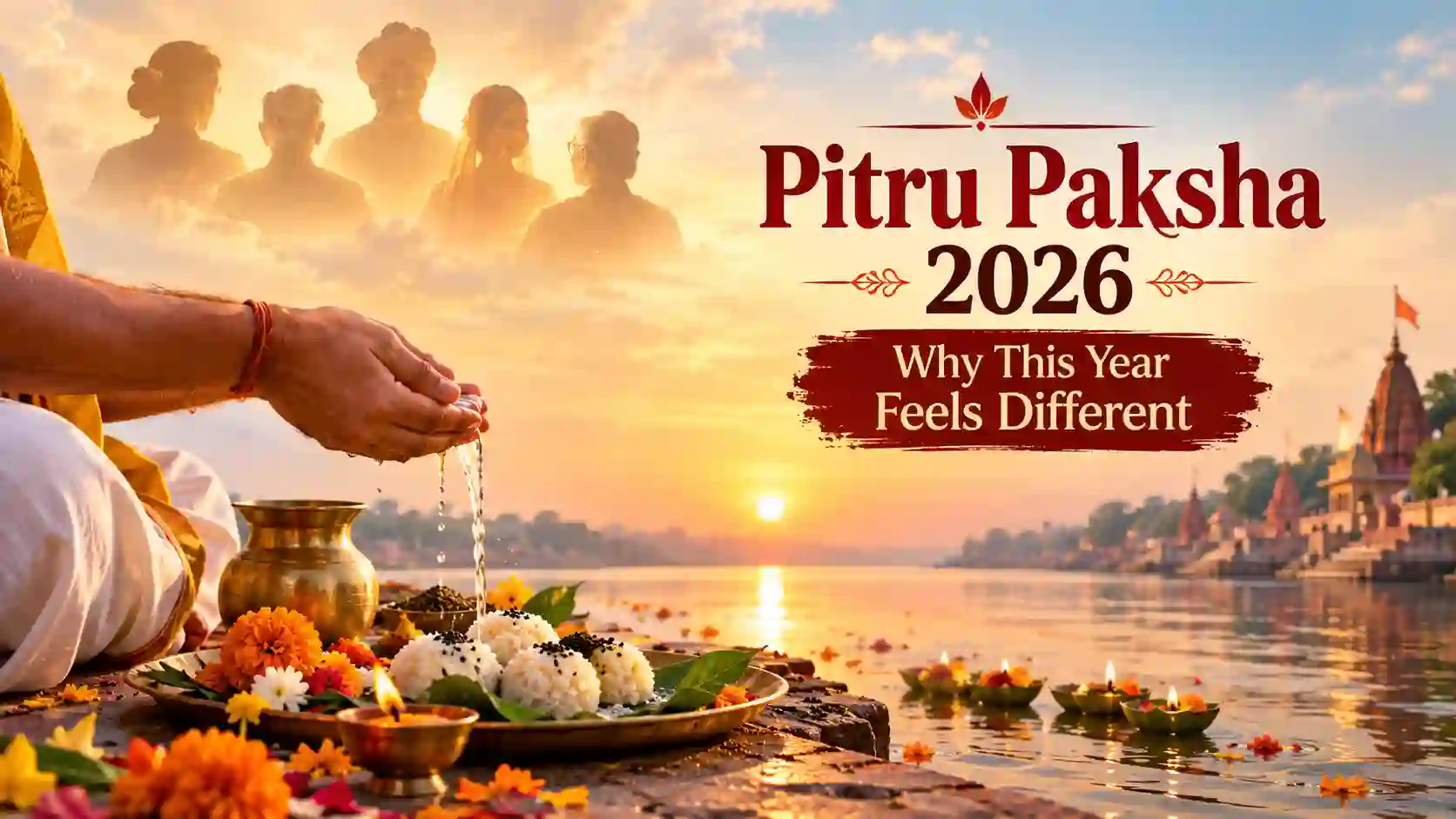
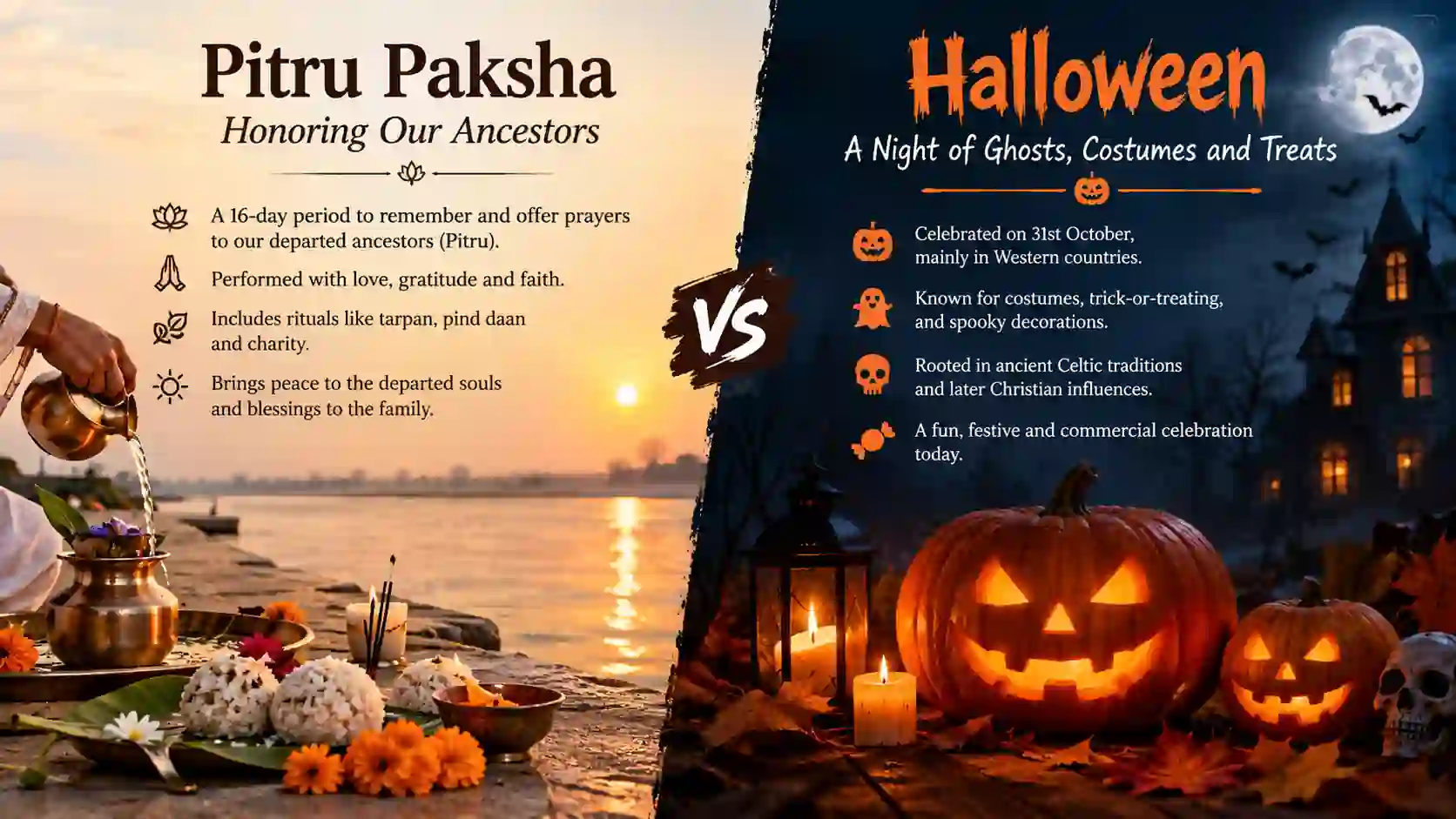
That is roughly where the resemblance ends. One is a sixteen-day Hindu observance of quiet ritual, water offerings, and remembered names. The other is a Celtic-rooted, Christian-reshaped, now largely commercial night of costumes and candy. Pitru Paksha 2026 runs from September 27 to October 10, and Halloween falls on its usual date of October 31 — so this year, the two are separated by about three weeks on the calendar and by a much wider gap in what they actually ask of the people observing them.
This isn’t an attempt to force two unrelated traditions into the same box. It’s a look at what each one is actually doing, where the ideas genuinely echo each other, and where they don’t overlap at all.
What Pitru Paksha Actually Involves
Pitru Paksha is a sixteen-day period in the Hindu lunar calendar, falling in the dark fortnight of Ashwin, set aside specifically for honoring one’s deceased ancestors, or pitrs. It isn’t a festival in the sense of celebration — it’s closer to a structured season of remembrance, built around the belief that the living owe a debt (pitru rin) to the generations who came before them, and that this debt is repaid through ritual, not sentiment alone.
The core practices are consistent across regions, even when the details vary:
- Tarpan — offering water mixed with sesame seeds to ancestors, usually at sunrise
- Shraddha — a formal ritual performed on the tithi (lunar day) matching an ancestor’s death, often with a priest or family elder officiating
- Pind Daan — offering rice balls believed to nourish the departed soul on its onward journey
- Feeding crows, cows, and Brahmins — considered indirect ways of reaching the ancestors themselves
The period closes on Sarvapitri Amavasya, the new moon day reserved for every ancestor whose exact death date has been forgotten or is unknown — a kind of catch-all remembrance that makes sure no one in the family line is left out. For a closer look at this year’s specific dates and the astrological context around them, see our full guide to Pitru Paksha 2026, and for one of the more specific observances within this period, Chaturdashi Shraddha explains the ritual set aside for ancestors who died suddenly or violently.
What Halloween Actually Involves
Halloween’s roots go back roughly 3,000 years to Samhain, a festival marking the Celtic new year, observed by peoples across what is now Ireland, the UK, and northern France. October 31 was the last night of the old year, and the Celts believed the boundary between the living and the dead grew thin enough that spirits could cross over. Bonfires were lit, animal skins and heads were worn as costumes, and offerings were left out — partly to honor the dead, partly to keep the more troublesome spirits at bay.
Christianity reshaped the holiday in layers over the following centuries. In the 7th century, Pope Boniface IV established a feast honoring Christian martyrs; Pope Gregory III later widened it to all saints and moved it to November 1, creating All Saints’ Day. By around 1000 CE, the Church had added All Souls’ Day on November 2, and the night before both — October 31 — became known as All Hallows’ Eve, which eventually contracted into “Halloween.” History.com has a fuller account of how each layer was added.
The holiday that Irish immigrants carried to the United States in the 19th century, and that expanded into trick-or-treating and mass costume culture through the 20th, is several steps removed from Samhain’s original bonfires and even further from its Christianized version. For most people celebrating it today, Halloween has very little to do with actually honoring specific ancestors — it’s closer to a community and pop-culture holiday that happens to be built on a much older foundation.
Pitru Paksha vs. Halloween: The Core Difference
Set side by side, the two traditions aren’t really doing the same job, even though both technically involve “the dead.”
Pitru Paksha treats ancestors as an ongoing part of the family — not gone, just in a different state, still owed food, water, and acknowledgment. The rituals are specific to individuals: a particular tithi for a particular relative, a particular offering meant to reach them directly. It asks something of the person performing it — attention, discipline, sometimes travel to a sacred site like Gaya or Varanasi.
Halloween, in its earliest form, was more about managing the presence of the dead than honoring them individually — keeping wandering spirits appeased or distracted rather than nourishing named ancestors. And in its modern form, that original concern has mostly dissolved into costumes, decoration, and candy. There’s no expectation that a person dressing as a superhero on October 31 is thinking about anyone they’ve lost.
| Pitru Paksha | Halloween | |
| Origin | Hindu lunar calendar, Vedic ancestor worship | Celtic Samhain, later merged with Christian All Souls’ Day |
| Focus | Specific, named ancestors | Spirits and the dead in general |
| Core action | Ritual offerings (tarpan, pind daan, shraddha) | Costumes, bonfires historically; candy and parties today |
| Tone | Solemn, reflective, duty-bound | Originally protective; now largely festive |
| 2026 dates | September 27 – October 10 | October 31 |
Where the Two Quietly Overlap
For all their differences, a few things do connect them. Anyone running a Pitru Paksha vs. Halloween comparison further back than the surface rituals will notice the same seasonal logic underneath both.
Both are anchored to a specific window in the calendar rather than treating death as something to acknowledge whenever convenient. Both grew out of agrarian, harvest-season timing — Pitru Paksha falls right after the monsoon harvest in the Hindu calendar, while Samhain marked the end of the Celtic harvest and the start of the “dark half” of the year. Neither tradition invented the idea of a thin veil between worlds out of nowhere; both reflect older, pre-modern instincts about the turning of the seasons and the presence of those who came before.
Food offerings show up in both, too, even if the intent differs. Tarpan and pind daan are meant to directly nourish ancestors. Centuries ago, some regions of the British Isles practiced “souling,” where people went door to door offering prayers for the dead in exchange for small cakes — a distant, half-forgotten ancestor of modern trick-or-treating, and one of the few points where Halloween’s history brushes up against something closer to what Pitru Paksha still does today.
Frequently Asked Questions
Is Halloween connected to Hindu ancestor worship in any way?
No. Halloween developed from Celtic and later Christian traditions in Europe, entirely independent of Hindu practice. Any resemblance to Pitru Paksha comes from both cultures separately arriving at the idea that the dead deserve acknowledgment at a set time of year, not from any shared origin.
Did Pitru Paksha ever involve costumes, bonfires, or trick-or-treating?
No. Pitru Paksha has always centered on water and food offerings, prayer, and ritual performed by family members, typically at home or at a sacred site. It has no costume or door-to-door tradition of any kind.
Why do both fall in autumn?
Largely coincidence of separate calendar systems rather than a shared source. Pitru Paksha follows the Hindu lunar calendar and lands in the fortnight after the harvest month of Bhadrapada. Samhain followed the Celtic solar calendar and marked the close of the harvest season in the British Isles. Different systems, similar agricultural logic.
Is it disrespectful to run a Pitru Paksha vs. Halloween comparison?
Not if the comparison is honest about the differences. Pitru Paksha is a solemn religious duty rooted in specific scriptural and family practice; Halloween today is largely secular entertainment with a religious and pagan history behind it. Looking at both side by side is useful for understanding how different cultures have approached the same basic human discomfort with death — it isn’t a claim that the two are equivalent.
Is there a Hindu equivalent to Halloween?
Not really, in the sense of a costumed, spirit-themed community holiday. Pitru Paksha is the closest point of comparison because it also deals with the dead, but its purpose — nourishing and honoring specific ancestors — is fundamentally different from Halloween’s modern form.
Neither tradition needs the other to make sense. Pitru Paksha stands on its own as a structured act of remembrance, built around real names and real debts owed to the people who came before. Halloween, whatever its distant roots in Samhain and All Souls’ Day, has become something closer to shared seasonal theater. What a Pitru Paksha vs. Halloween comparison really comes down to is this: the sense that autumn is a season for looking back, and that the dead, in some form, are still worth making room for.