

Ravana: Villain or Legendary Scholar?
When people hear the name Ravana, they often think of the ten-headed demon king who abducted Sita and fought Lord Rama in the epic Ramayana. However, Hindu mythology presents a far more complex personality than a simple villain.
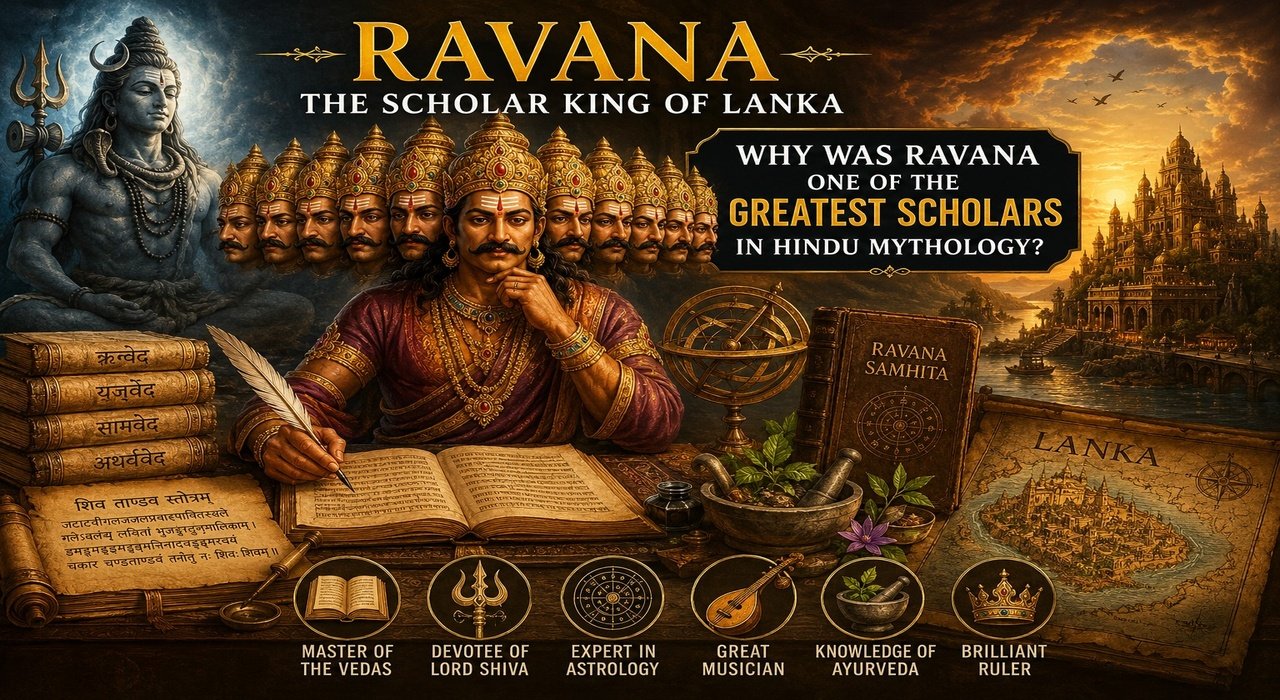
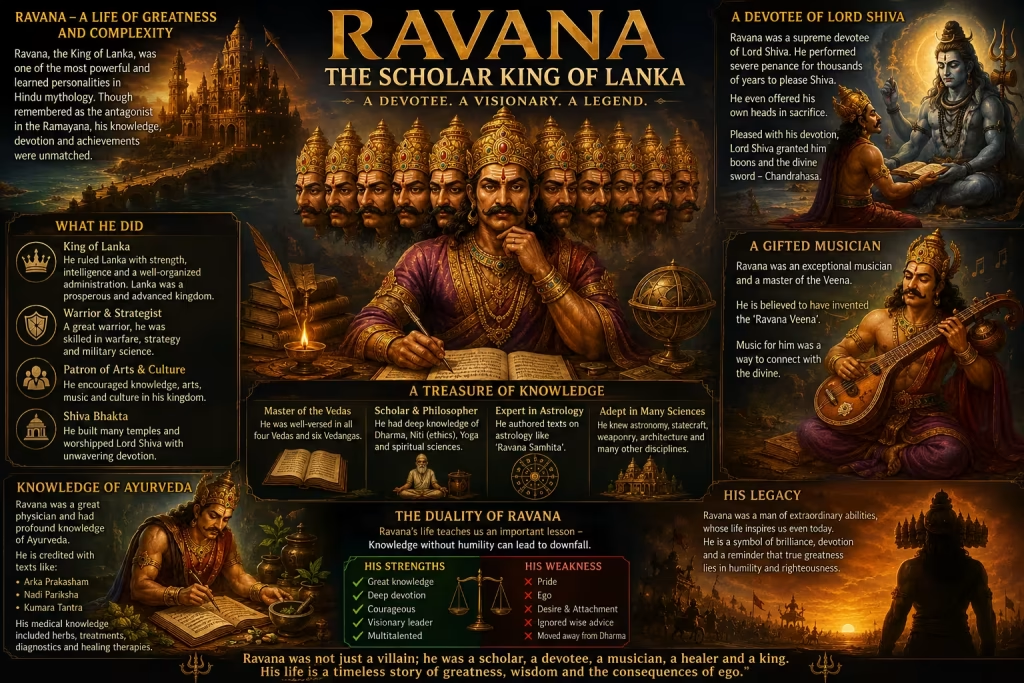
Ravana was not merely a powerful king of Lanka. He was a brilliant scholar, an accomplished musician, a master astrologer, a skilled physician, and one of the greatest devotees of Lord Shiva. Many ancient texts describe him as possessing immense knowledge that surpassed even many sages of his time.
This raises an interesting question: Why was Ravana considered one of the greatest scholars in Hindu mythology despite his downfall?
The answer lies in his extraordinary learning, wisdom, and achievements that continue to fascinate scholars and spiritual seekers even today.
The Divine Birth of Ravana
Ravana was born to the sage Vishrava and Kaikesi. His father belonged to the lineage of the great sage Pulastya, one of the mind-born sons of Lord Brahma.
Being born into a family of learned sages, Ravana received a rigorous education from an early age. He mastered various branches of knowledge including:
- The four Vedas
- Six Vedangas
- Astrology
- Ayurveda
- Music
- Warfare
- Statecraft
- Spiritual sciences
Unlike ordinary kings, Ravana combined royal power with intellectual brilliance, making him a unique figure in Hindu mythology.
Why Did Ravana Have Ten Heads?
One of Ravana’s most iconic features is his ten heads. While many interpret them literally, several scholars believe they symbolize his vast knowledge.
The ten heads are often associated with mastery over:
- The Four Vedas
- The Six Shastras
Together, they represent complete knowledge of ancient Hindu learning.
Another interpretation suggests the ten heads symbolize human emotions and intellect, indicating Ravana’s extraordinary mental capabilities.
Whether symbolic or literal, the ten heads became a powerful representation of his unparalleled wisdom.
Ravana’s Mastery of the Vedas
One of Ravana’s most iconic features is his ten heads. While many interpret them literally, several scholars believe they symbolize his vast knowledge.
The ten heads are often associated with mastery over:
- The Four Vedas
- The Six Shastras
Together, they represent complete knowledge of ancient Hindu learning.
Another interpretation suggests the ten heads symbolize human emotions and intellect, indicating Ravana’s extraordinary mental capabilities.
Whether symbolic or literal, the ten heads became a powerful representation of his unparalleled wisdom.
Ravana’s Mastery of the Vedas
One of the strongest reasons Ravana is regarded as a great scholar is his deep understanding of the Vedas.
Ancient scriptures describe him as a highly learned Brahmin who had memorized and mastered sacred texts.
The Vedas contain knowledge related to:
- Spirituality
- Rituals
- Philosophy
- Cosmic laws
- Ethics
Ravana possessed such profound knowledge that even great sages respected his intellectual abilities.
His expertise in Vedic rituals enabled him to perform complex yajnas and spiritual ceremonies that very few could accomplish.

Ravana: The Great Devotee of Lord Shiva
Ravana’s devotion to Lord Shiva is legendary.
According to Hindu traditions, he performed intense penance for thousands of years to gain Shiva’s blessings.
One famous story tells how Ravana offered his own heads one by one into a sacrificial fire as an act of devotion. Impressed by his dedication, Lord Shiva restored them and granted him immense powers.
His devotion gave birth to one of Hinduism’s most revered hymns:
Shiva Tandava Stotram
The Shiva Tandava Stotram is considered a masterpiece of Sanskrit literature.
Even today, scholars admire it for:
- Its poetic beauty
- Complex meter
- Spiritual depth
- Philosophical richness
The composition demonstrates Ravana’s exceptional command of Sanskrit language and devotional literature.
Ravana’s Extraordinary Knowledge of Astrology
Many traditions credit Ravana with remarkable expertise in astrology.
The ancient text known as Ravana Samhita is believed to contain teachings attributed to him.
This work discusses:
- Planetary influences
- Horoscopes
- Predictions
- Remedies
- Astrological calculations
Whether entirely authored by Ravana or inspired by his teachings, the text reflects the strong association between Ravana and advanced astrological knowledge.
Even today, astrologers study Ravana Samhita for its unique insights.
Ravana the Musician
Few people know that Ravana was also an accomplished musician.
Ancient legends describe him as a master of the veena.
A unique musical instrument called the Ravana Veena is traditionally linked to him.
His understanding of:
- Sound vibrations
- Musical theory
- Rhythm
- Devotional music
made him one of the most talented artists of his era.
Music was not merely entertainment for Ravana—it was a spiritual path to connect with divine energies.
Ravana’s Knowledge of Ayurveda
Ravana was also associated with medical science.
Several traditional Ayurvedic texts are attributed to him, including:
- Arka Prakasham
- Nadi Pariksha
- Kumara Tantra
These works discuss:
- Herbal medicines
- Diagnosis techniques
- Child healthcare
- Healing therapies
Although scholars debate their exact origins, these texts highlight Ravana’s reputation as a physician and healer.
His understanding of medicinal plants was considered extraordinary.
The Brilliant Administrator of Lanka
Ravana was not only a scholar but also an exceptional ruler.
Descriptions of Lanka portray it as a prosperous and technologically advanced kingdom.
Features of his kingdom included:
- Golden palaces
- Organized administration
- Strong economy
- Advanced architecture
- Well-trained military
Citizens of Lanka reportedly enjoyed wealth and stability under his rule.
His governance demonstrated that intellectual excellence can contribute to effective leadership.
The Debate Between Ravana and Rama
One fascinating aspect of the Ramayana is that Lord Rama himself respected Ravana’s knowledge.
According to traditional narratives, when Ravana was mortally wounded on the battlefield, Rama advised Lakshmana to seek wisdom from him.
Ravana then shared valuable lessons about:
- Leadership
- Time management
- Decision-making
- Human nature
This story highlights an important principle of Hindu philosophy:
Wisdom can exist even in those who make grave mistakes.
Ravana’s knowledge remained worthy of respect despite his moral failures.
What Led to Ravana’s Downfall?
If Ravana was so wise, why did he fall?
The answer lies in one of the greatest lessons of Hindu mythology:
Knowledge Without Humility Is Dangerous
Despite his intelligence, Ravana became consumed by:
- Ego
- Pride
- Arrogance
- Desire for power
His abduction of Sita became the turning point that led to his destruction.
He ignored wise advice from:
- Vibhishana
- Mandodari
- Several ministers
His refusal to correct his mistakes ultimately caused the downfall of Lanka.
The Ramayana teaches that wisdom alone is not enough. True greatness requires humility and righteousness.
Lessons We Can Learn from Ravana
Ravana remains one of the most fascinating characters in Hindu mythology because he embodies both greatness and failure.
1. Pursue Knowledge Relentlessly
Ravana dedicated his life to learning and mastering various disciplines.
2. Develop Multiple Skills
He excelled in spirituality, science, medicine, music, and governance.
3. Respect the Power of Devotion
His devotion to Lord Shiva demonstrates the transformative power of faith.
4. Control Ego
His downfall reminds us that arrogance can destroy even the most gifted individuals.
5. Use Knowledge Wisely
Knowledge becomes meaningful only when guided by ethics and wisdom.
Was Ravana a Villain or a Scholar?
The truth is that Ravana was both.
He was a powerful king whose actions violated dharma, making him the antagonist of the Ramayana.
At the same time, he was:
- A Vedic scholar
- A philosopher
- A musician
- An astrologer
- A physician
- A devotee of Shiva
This duality is what makes Ravana one of the most intriguing personalities in Hindu mythology.
Rather than viewing him as purely evil, Hindu traditions often present him as a tragic figure whose immense knowledge was overshadowed by his unchecked ego.
The question, “Why Was Ravana One of the Greatest Scholars in Hindu Mythology?” has many answers.
His mastery of the Vedas, deep devotion to Lord Shiva, expertise in astrology and Ayurveda, musical genius, and exceptional leadership made him one of the most learned figures in ancient Hindu lore.
Yet his story also serves as a timeless reminder that wisdom without humility can lead to ruin. Ravana’s life illustrates both the heights of intellectual achievement and the dangers of arrogance.
This combination of brilliance and tragedy is why Ravana continues to be studied, debated, and remembered thousands of years after the events of the Ramayana.
His legacy teaches us that true greatness lies not only in acquiring knowledge but also in using it with humility, compassion, and righteousness.