
Krishna Janmashtami, one of the most joyously celebrated festivals in the Hindu calendar, marks the birth anniversary of Lord Krishna — the eighth avatar of Lord Vishnu. In 2026, devotees across India and around the world are gearing up to celebrate this sacred occasion with devotion, fasting, midnight prayers, and festive traditions passed down for generations. Here’s everything you need to know about Janmashtami 2026 — the exact date, puja muhurat, vrat vidhi, and the significance behind this beloved festival.
Janmashtami date 2026
Krishna Janmashtami 2026 will be celebrated on **Friday, September 4, 2026**. The festival falls on the Ashtami Tithi (eighth day) of the Krishna Paksha (waning moon phase) in the Hindu month of Bhadrapada, which is also when the Rohini Nakshatra is traditionally believed to align — the same nakshatra under which Lord Krishna is said to have been born at midnight in Mathura over 5,000 years ago.
Both the Smarta and Vaishnav (ISKCON) traditions largely observe Janmashtami on the same date in 2026, though it’s always worth double-checking with your local temple or Panchang, since observance dates can occasionally differ by a day depending on regional tithi calculations and sunrise timings.
Janmashtami 2026 Puja Muhurat
The most significant puja window on Janmashtami is the **Nishita Kaal Puja Muhurat** — the auspicious midnight period considered most sacred, since Krishna is believed to have been born at the stroke of midnight. This is when devotees perform the main Krishna Janmotsav puja, cradle rocking (jhulan), and abhishekam of the deity.
Because the exact Nishita Puja timing depends on your city’s sunrise/moonrise and the precise start and end of the Ashtami Tithi, the minute-level muhurat can shift slightly from one location to another. For the most accurate, location-specific puja muhurat for Janmashtami 2026 (Ashtami Tithi start/end and Nishita Kaal window), we recommend checking a live Panchang for your city closer to the date. As a general rule of thumb:
Main puja window: Midnight (around 12:00 AM) on September 4–5, 2026
Fasting period :From sunrise on September 4 until the Nishita Puja is completed after midnight
Parana (breaking the fast): After the midnight puja, or the next morning as per family/regional tradition
Janmashtami Vrat Vidhi (Fasting Rituals)
Observing a vrat (fast) on Janmashtami is considered highly meritorious. Here’s the traditional step-by-step vidhi followed by devotees:
1. Sankalp (Vow): Begin the day with a bath and take a sankalp, vowing to observe the fast with devotion to Lord Krishna.
2. Fasting through the day: Most devotees observe a nirjala (waterless) or phalahar (fruits-only) fast through the day, breaking it only after the midnight puja.
3. Cleaning and decorating the puja space: Homes and temples are cleaned and decorated with flowers, rangoli, and small cradles (jhula) for baby Krishna.
4. Midnight puja: At the Nishita Muhurat, an idol or image of Bal Gopal (infant Krishna) is bathed with panchamrit (milk, curd, honey, ghee, and sugar), dressed in new clothes, and placed in a decorated cradle.
5. Aarti and bhajans: Devotees sing bhajans, perform aarti, and rock the cradle to symbolize Krishna’s birth.
6. Offering bhog: Sweets like makhan-mishri (butter and sugar), panjiri, and other traditional dishes are offered as prasad.
7. Breaking the fast: The fast is broken after the midnight puja by partaking of the prasad, or the next morning depending on family custom.
Significance of Janmashtami
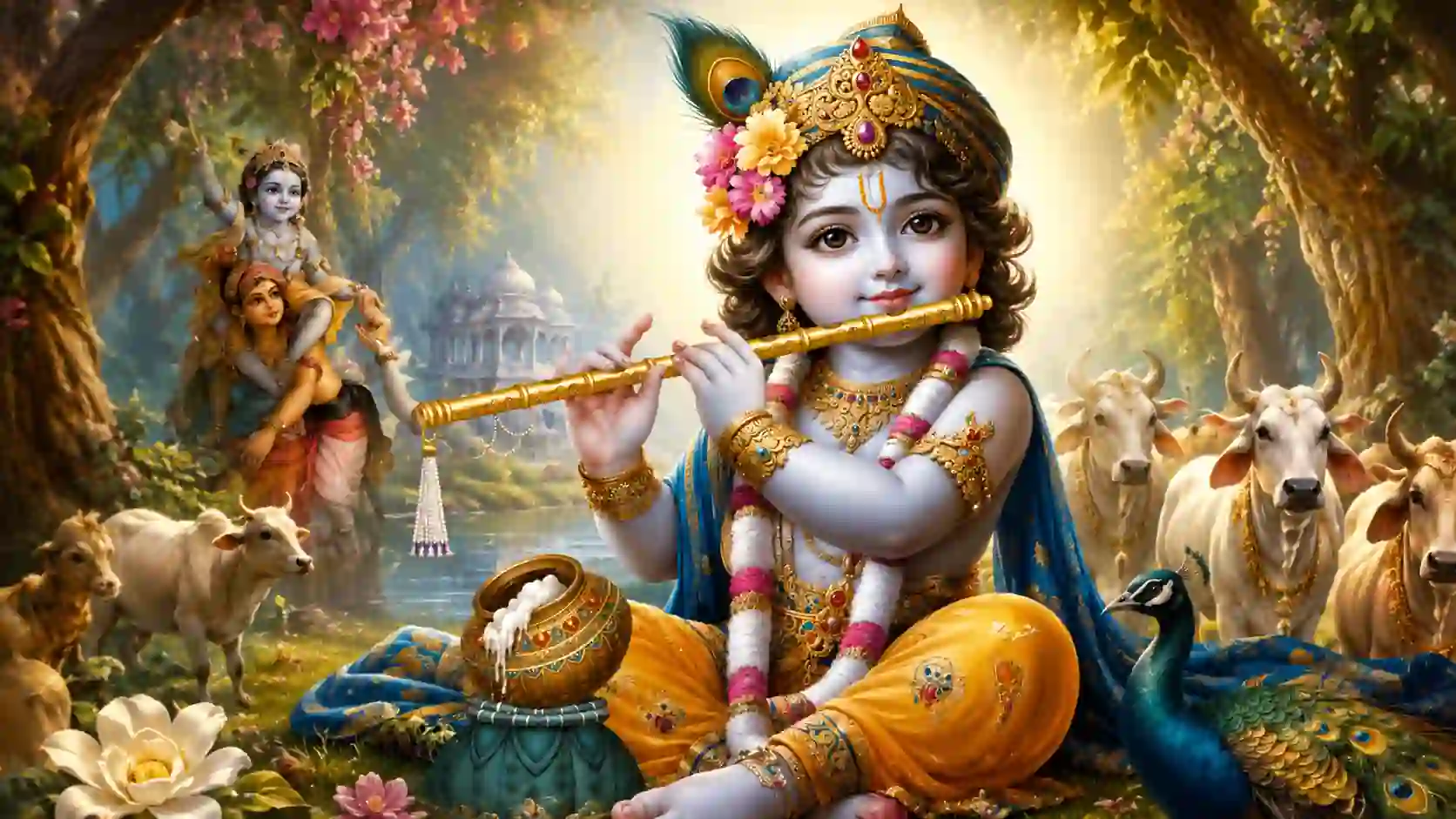
Janmashtami holds deep spiritual and cultural significance in Hinduism. It commemorates the birth of Lord Krishna in Mathura, born to Devaki and Vasudev, to rid the earth of tyranny and restore dharma (righteousness). Krishna’s life — from his mischievous childhood in Gokul and Vrindavan to his profound teachings in the Bhagavad Gita on the battlefield of Kurukshetra — continues to inspire millions.
The festival is a celebration of:
The triumph of good over evil as Krishna’s birth signified the end of King Kansa’s tyranny
Divine love and devotion (bhakti) central to the Krishna tradition
Dharma and righteous living as taught through Krishna’s life and the Bhagavad Gita
Krishna Janmashtami Celebrations Across India
Janmashtami is celebrated with unmatched fervor across the country, with each region adding its own unique flavor to the festivities:
– **Mathura and Vrindavan (Uttar Pradesh):** The birthplace of Lord Krishna comes alive with elaborate celebrations at temples like Shri Krishna Janmasthan, Banke Bihari, and Prem Mandir, drawing lakhs of devotees.
– **Maharashtra:** Famous for **Dahi Handi**, celebrated the day after Janmashtami, where young men form human pyramids to break pots of curd suspended high above the streets, recreating young Krishna’s love for butter.
– **Gujarat:** The Dwarkadhish Temple in Dwarka and Ranchhodrai temples see grand celebrations with processions and devotional singing.
– **Manipur:** ISKCON and local temples host Ras Leela performances depicting scenes from Krishna’s life.
– **Across India and globally:** ISKCON temples worldwide organize midnight aartis, kirtans, and cultural programs, drawing devotees from all walks of life.
Final Thoughts
Janmashtami 2026, falling on Friday, September 4, is a wonderful opportunity to reconnect with devotion, tradition, and the timeless teachings of Lord Krishna. Whether you observe a full vrat, attend a midnight temple aarti, or simply celebrate with family, the spirit of Krishna Janmashtami is one of joy, faith, and renewal.
*Jai Shri Krishna!*