

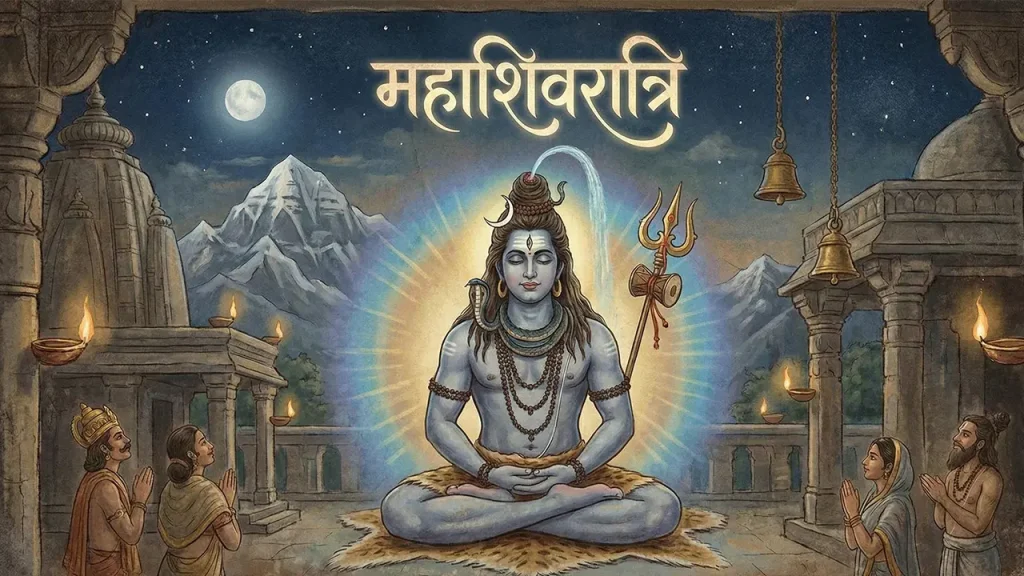
Maha Shivratri 2026 falls on Sunday, February 15, the great night dedicated to Lord Shiva. Maha Shivratri is observed with an all-night vigil, fasting and Shivling worship, and is especially significant at the twelve Jyotirlinga shrines across India.
Maha Shivratri 2026 Date and Tithi
Maha Shivratri 2026 falls on Phalgun Krishna Chaturdashi, Sunday, 15 February 2026 — the fourteenth day of the dark fortnight of Phalgun.

Significance of Maha Shivratri
Maha Shivratri, the “Great Night of Shiva”, falls on the fourteenth day of the dark fortnight of Phalgun and is regarded as one of the most significant nights in the Shaiva tradition. Several legends are associated with the day: one holds that it marks the night Lord Shiva performed his cosmic Tandava, the dance of creation, preservation and destruction; another describes it as the night of Shiva and Parvati’s divine wedding. A widely cited legend also recalls the Samudra Manthan (churning of the cosmic ocean), during which a deadly poison (halahala) emerged; to save creation from its effects, Shiva drank the poison and held it in his throat, turning it blue and earning him the name Neelkanth.
The night is considered especially auspicious for meditation and worship because Shiva is believed to be closest to his devotees at this time. Unlike most Hindu festivals, which are marked by celebration during the day, Maha Shivratri is primarily observed through the night with an all-night vigil (Jagran), reflecting the idea that awakening through the darkness leads to awareness and liberation from ignorance. It is especially significant at the twelve Jyotirlinga shrines across India, including Kashi Vishwanath (Varanasi), Mahakaleshwar (Ujjain) and Somnath (Gujarat), which see the largest gatherings of devotees on this night.
Maha Shivratri Puja Vidhi (Rituals)
- Fasting – Devotees observe a day-long fast, some taking no food or water (nirjala) and others permitting fruits and milk, breaking it only the next morning after the puja concludes.
- Four-prahar puja – The night is divided into four prahars (watches); devotees perform a Shivling abhishekam (ceremonial bathing) in each prahar, offering water, milk, honey, yogurt, ghee and sugarcane juice in turn.
- Bael Patra offering – Bael (bilva) leaves, considered especially dear to Shiva, are offered to the Shivling along with datura flowers, ash (vibhuti) and white flowers.
- Mantra chanting – Devotees chant Om Namah Shivaya and the Maha Mrityunjaya mantra throughout the night, and recite or listen to the Shiva Purana and Shiva Chalisa.
- Jagran (night vigil) – Many stay awake through the night in prayer, meditation and devotional singing (bhajans/kirtans) at home or in temples.
- Temple visits – Devotees visit Shiva temples, especially the twelve Jyotirlinga shrines, where special all-night ceremonies and processions are held.
Regional Celebrations of Maha Shivratri
Maha Shivratri is celebrated across India, with the largest gatherings at the twelve Jyotirlinga temples — including Kashi Vishwanath (Varanasi), Mahakaleshwar (Ujjain), Somnath (Gujarat) and Kedarnath (Uttarakhand) — and also widely observed at the Pashupatinath Temple in Nepal.
Frequently Asked Questions About Maha Shivratri
When is Maha Shivratri in 2026?
Maha Shivratri 2026 falls on Sunday, 15 February, on Phalgun Krishna Chaturdashi tithi.
What is the significance of Maha Shivratri?
Maha Shivratri honors Lord Shiva through an all-night vigil, commemorating his cosmic dance of creation and destruction and, in many traditions, his sacred union with Goddess Parvati.
Where is Maha Shivratri celebrated?
Maha Shivratri is celebrated across India, with the largest gatherings at the twelve Jyotirlinga temples and at the Pashupatinath Temple in Nepal.
Maha Shivratri falls in the same festive season as Raksha Bandhan and Janamashtami. Explore more Hindu festival dates and rituals on Mythology Mantra. Dates are cross-checked with DrikPanchang.