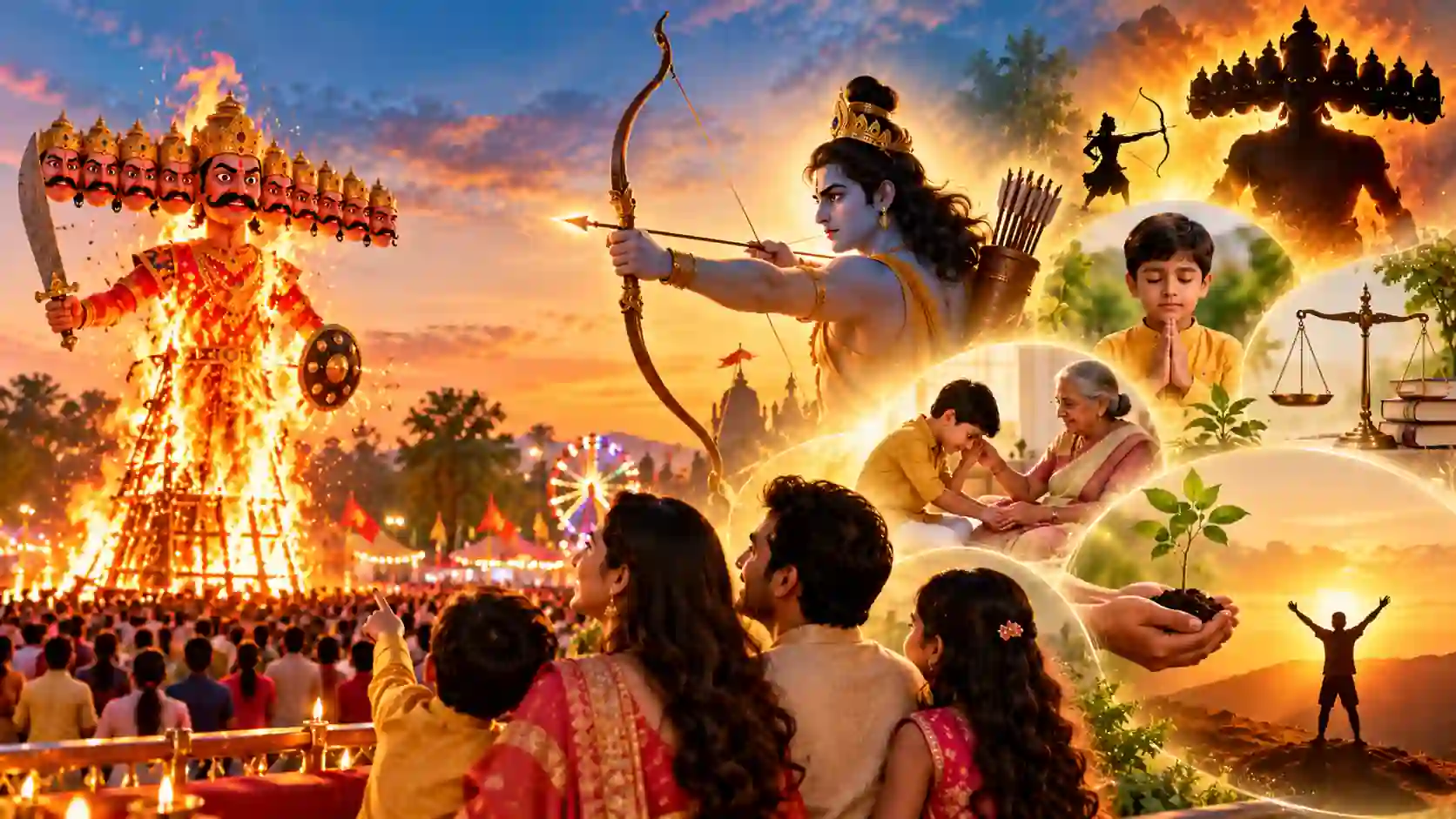


For many families, Dussehra has narrowed to a single event: watching Ravana burn. Yet the older Dussehra traditions are far richer, and most of them happen in the hours before the effigies are lit. Exchanging Shami leaves, worshipping Goddess Aparajita, crossing the village boundary, wearing the sprouted jaware from Navratri: these small rituals give Vijayadashami its texture. Dussehra 2026 falls on Tuesday, 20 October, with the New Delhi Vijay Muhurat at about 2:00 PM to 2:46 PM. Here are seven traditions worth bringing back this year.
1. Exchanging Shami (or Apta) Leaves
In Maharashtra, Karnataka and parts of central India, people exchange leaves of the Shami or Apta tree on Dussehra, calling them sona, gold, and wishing each other prosperity. The custom draws on the Mahabharata, in which the Pandavas hid their weapons in a Shami tree during their year incognito and retrieved them before battle. In Maharashtra, a popular story also connects the Apta leaves to a shower of gold coins linked to the young Kautsa and King Raghu. Whatever the story your family tells, handing an elder a leaf and touching their feet is a lovely way to begin the day.
2. Aparajita Puja
Aparajita means “the unconquered”. Many households worship Goddess Aparajita during the afternoon of Vijayadashami, often by drawing an eight-petalled lotus with rice or kumkum and invoking her at its centre. Some traditions place this puja in the Aparahna window, which in 2026 runs roughly from 1:14 PM to 3:32 PM in New Delhi. It’s a quiet ritual, easily done at home, and it ties the day back to the Goddess whose victory the festival also celebrates.
3. Seema Ullanghan: Crossing the Boundary
Seema Ullanghan or Seemollanghan, “crossing the boundary”, was traditionally the day kings set out on campaigns after the monsoon. Villagers would walk to the edge of the settlement, worship the Shami tree there, and return. The practice survives in parts of Maharashtra and Karnataka. A modern equivalent is simple: step out together as a family on Dussehra afternoon, perhaps to a temple or the Shami tree in your area, and treat it as the start of a new season of effort.
4. Looking for the Neelkanth Bird
In parts of North India, spotting a Neelkanth, the Indian roller with its bright blue wings, on Dussehra is considered auspicious. The bird’s name, “blue-throated”, is also an epithet of Shiva. It’s a charming excuse to spend a few minutes outdoors looking up. One caution: the Indian roller is a wild bird, and capturing or caging it for festival viewing harms it. Look, don’t catch.
5. Shastra and Ayudha Puja
Historically, Rajput and Maratha households worshipped weapons on Vijayadashami, and in South India, Ayudha Puja honours tools, vehicles and instruments, often on Navami. Today, the tradition extends naturally to laptops, account books, musical instruments and the tools of any trade. Clean them, place a tilak and flowers, and take a moment of gratitude for your livelihood. Our article on Ayudha Pooja explains the custom in more detail.
6. Wearing the Navratri Jaware
If your family sowed barley (jau) beside the kalash at the start of Navratri, the green shoots are ready by Dussehra. In Punjab, Haryana and parts of North India, these shoots, called jaware or khetri, are offered to the Goddess and then tucked behind the ear or into a cap or turban by family members as a sign of blessing and prosperity. Remaining sprouts are respectfully immersed or placed in soil. It’s a lovely closing link between Navratri and Dussehra that many urban families have let go.
7. Starting Something New
Vijayadashami is widely considered an auspicious day to begin something. In Kerala and parts of South India, children are introduced to writing through Vidyarambham; see our Vidyarambham guide. Elsewhere, people begin music lessons, open new account books or start a new business on this day. Gujarat even has its own food tradition: plates of crisp fafda and hot jalebi on Dussehra morning. Pick one new beginning for your household this year, however small.
Fitting These Dussehra Traditions Into One Tuesday
Because Dussehra 2026 falls on a working Tuesday, you may not manage all seven. A practical order: Ayudha or book puja and jaware in the morning, Aparajita puja and the Shami leaf exchange in the afternoon around the Vijay Muhurat, and Ravan Dahan after sunset. For the full date, muhurat and story, see our Dussehra 2026 guide.
Frequently Asked Questions
Why are Shami leaves called gold on Dussehra?
Exchanging Shami or Apta leaves as “sona” is a custom wishing each other prosperity. It draws on stories from the Mahabharata and popular regional tales associating the leaves with gold.
What is Aparajita puja?
It is the worship of Goddess Aparajita, “the unconquered”, usually in the afternoon of Vijayadashami, for victory and protection.
Is seeing a Neelkanth bird on Dussehra lucky?
In some North Indian traditions it is considered auspicious. It’s a folk belief, and the bird should only be observed in the wild, never caught.
What should I do with Navratri jaware on Dussehra?
Many families offer them to the Goddess, wear a few shoots behind the ear for blessing, and immerse or plant the rest respectfully.
Small Rituals, Lasting Memories
The effigies burn in minutes. It’s the quieter customs that children remember for decades. Choose two or three of these traditions this Dussehra, explain the story behind each, and the day will mean more than fireworks. For more on the festival’s meaning, read Vijayadashami and its modern relevance.