
A Seeker from the Margins
In the vast and intricate landscape of Indian mythology, where gods descend to Earth and kings battle for dharma, the story of Shabari is quiet, humble, and profoundly moving. She is not a queen, a warrior, or a sage.
She is an old tribal woman, living in the forest, waiting for a promise to be fulfilled. Her devotion is not marked by elaborate rituals or scholarly knowledge; it is marked by simplicity, sincerity, and unwavering faith.
Her story, found in the Ramayana, is a testament to the power of bhakti (devotion) that transcends caste, age, and social status. Her encounter with Lord Rama is one of the most touching moments in the epic, reminding us that the divine does not seek perfection; it seeks purity of heart.
Shabari’s Origins: A Life of Simplicity and Faith
She was born into a tribal community, considered untouchable by orthodox society. From a young age, she was drawn to spiritual life, seeking meaning beyond the customs of her people. Her yearning led her to the hermitage of Sage Matanga, who accepted her as a disciple despite societal norms.
In the forest, she lived a life of service and devotion. She cleaned the ashram, gathered fruits, and listened to the teachings of her guru. Her heart was filled not with ambition, but with love, for her guru, for the forest, and for the divine.
The Promise of Rama: A Guru’s Final Blessing
Before Sage Matanga left his mortal body, he gave Shabari a promise: one day, Lord Rama would visit her. This promise became the axis of her life. Every day, she waited.
Every morning, she cleaned the path, gathered berries, and prepared for the arrival of the divine guest. Years passed. She grew old. But her faith never wavered. She believed in her guru’s words with the innocence of a child and the strength of a sage.
The Forest as Temple: Sacredness in Nature
Shabari’s devotion was not confined to temples or rituals. Her forest became her temple. The trees were her companions, the birds her choir, and the fruits her offerings. She lived in harmony with nature, seeing divinity in every leaf and stone.
This aspect of her story reflects the indigenous spirituality of India, where the divine is not distant, but present in the earth, the sky, and the silence of the woods.
Rama’s Arrival: The Fulfillment of Faith
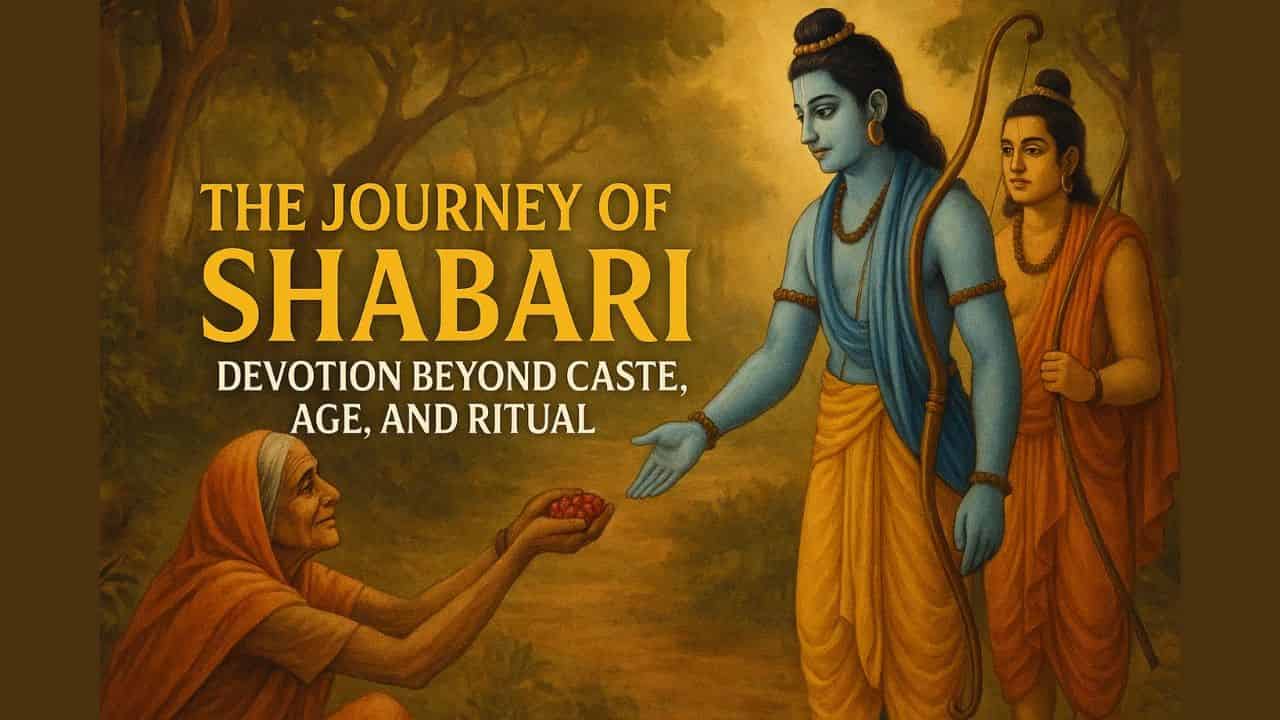
When Rama, searching for Sita, entered the forest with Lakshmana, he came upon Shabari’s hut. She welcomed him with trembling hands and a heart overflowing with joy. She offered him berries, each of which he tasted to ensure it was sweet.
This act, often misunderstood, was not disrespect; it was love. She wanted to give Rama only the best. And Rama, in his grace, accepted the tasted berries with a smile, recognizing the purity of her intention.
The Power of Bhakti: Beyond Ritual and Knowledge
Shabari’s devotion was not based on Vedic rituals or philosophical debates. She did not chant mantras or perform yajnas. Her bhakti was simple, waiting, serving, loving. And it was this simplicity that touched Rama’s heart.
In the Ramayana, Rama declares that he is more pleased by the love of a devotee than by the offerings of kings. Shabari becomes the embodiment of this truth, a devotee whose heart was her altar.
Symbolism of the Berries: Sweetness of Surrender
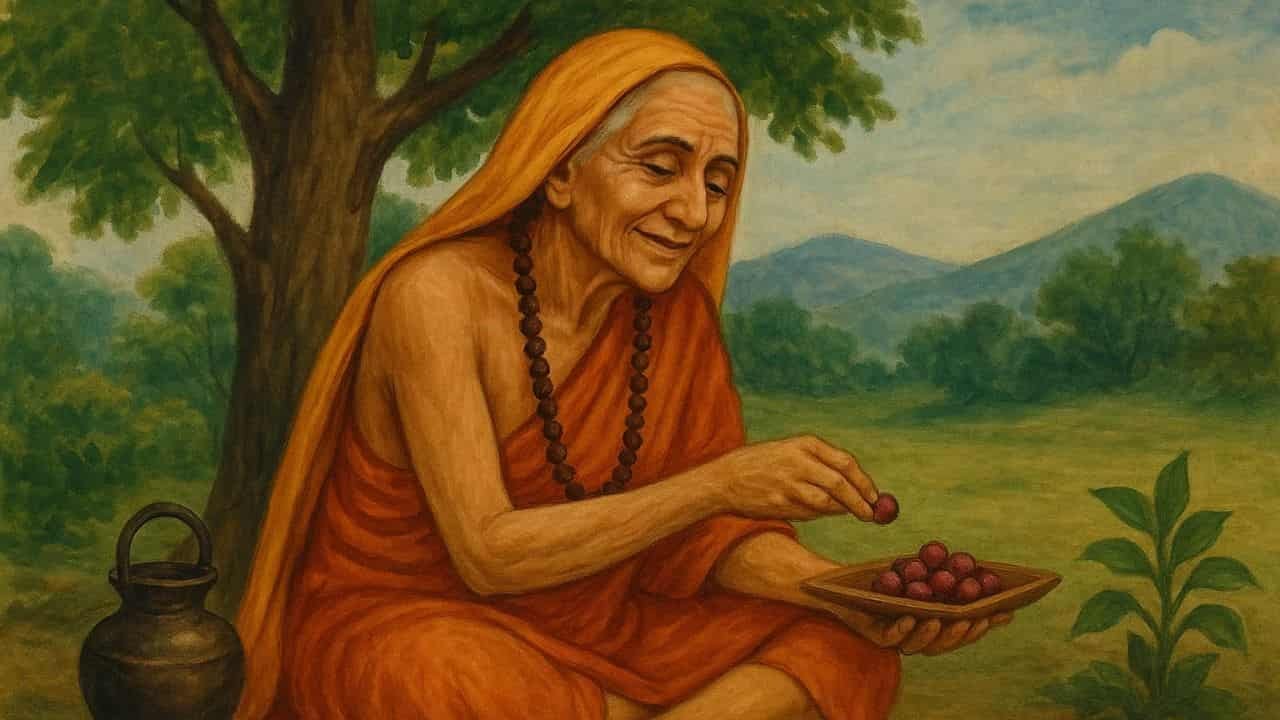
The berries that Shabari offered are symbolic. They represent the sweetness of surrender, the taste of unconditional love. By tasting each berry, she ensured that her offering was perfect, not in form, but in feeling.
Rama’s acceptance of the berries breaks social norms. It shows that the divine does not judge by caste or ritual; it responds to love.
Shabari and the Bhakti Movement
Though her story predates the Bhakti movement, Shabari is often seen as its precursor. Her life reflects the core tenets of bhakti:
- Personal connection with the divine
- Rejection of caste-based exclusion
- Emphasis on love over ritual
- Spiritual equality
Saints like Kabir, Mirabai, and Ravidas echoed Shabari’s spirit, challenging orthodoxy and celebrating devotion from the margins.
Interpretations Across Traditions
Different versions of the Ramayana offer varied portrayals of Shabari. In Valmiki’s Ramayana, her story is brief but poignant. In regional retellings, especially in tribal and folk traditions, she is given more prominence.
In some versions, she is seen as a yogini, in others as a mother figure. Her story adapts to the cultural lens of each region, but the essence remains: devotion beyond boundaries.
Shabari in Art and Literature
Shabari’s story has inspired poets, painters, and playwrights. Her image, an old woman offering berries to Rama, is iconic. It captures the essence of humility, love, and divine acceptance.
In modern literature, she is often portrayed as a symbol of spiritual feminism, a woman who defies societal norms to follow her inner calling.
Lessons from Shabari’s Life
Shabari’s journey offers profound lessons:
- Faith is not measured by knowledge, but by sincerity.
- Devotion is accessible to all, regardless of birth or status.
- Waiting, when filled with love, becomes worship.
- The divine responds to the heart, not to ritual.
Her life is a reminder that spirituality is not about reaching the divine; it is about preparing the heart to receive it.
Shabari and Social Inclusion
Shabari’s acceptance by Rama challenges caste hierarchies. It affirms that spiritual worth is not determined by social labels. Her story has been embraced by Dalit and tribal communities as a symbol of dignity and divine recognition.
In a society still grappling with exclusion, Shabari’s story remains relevant. It calls for a spirituality that includes, uplifts, and honours every seeker.
The Feminine in Devotion: Shabari’s Quiet Strength
Shabari’s devotion is deeply feminine, not in weakness, but in nurturing, patience, and emotional depth. She does not fight battles or preach doctrines.
She waits, she serves, she loves.
Her strength lies in her softness. Her power lies in her surrender. She represents a form of spiritual femininity that is often overlooked but profoundly transformative.
Shabari and the Concept of Moksha
Though she never speaks of liberation, Shabari attains moksha through her devotion. Rama blesses her, and she merges into the divine. Her path is not through renunciation or knowledge; it is through love.
This challenges conventional paths to liberation. It suggests that bhakti, when pure, is enough. That the heart, when surrendered, becomes the gateway to eternity.
The Eternal Wait That Became Worship
Shabari’s story is not grand; it is gentle. It does not roar, it whispers. But in that whisper lies a truth that shakes the foundations of orthodoxy. That the divine does not dwell in palaces, it walks into huts.
That it does not seek perfection, it seeks love. Her journey is a reminder that devotion is not about doing, it is about being. That waiting, when filled with faith, becomes worship.
And that the divine, when it arrives, does not ask for rituals, it asks for berries, tasted with love. In the forest of life, may we all be like Shabari, waiting, loving, and ready to offer our hearts, one sweet fruit at a time.