
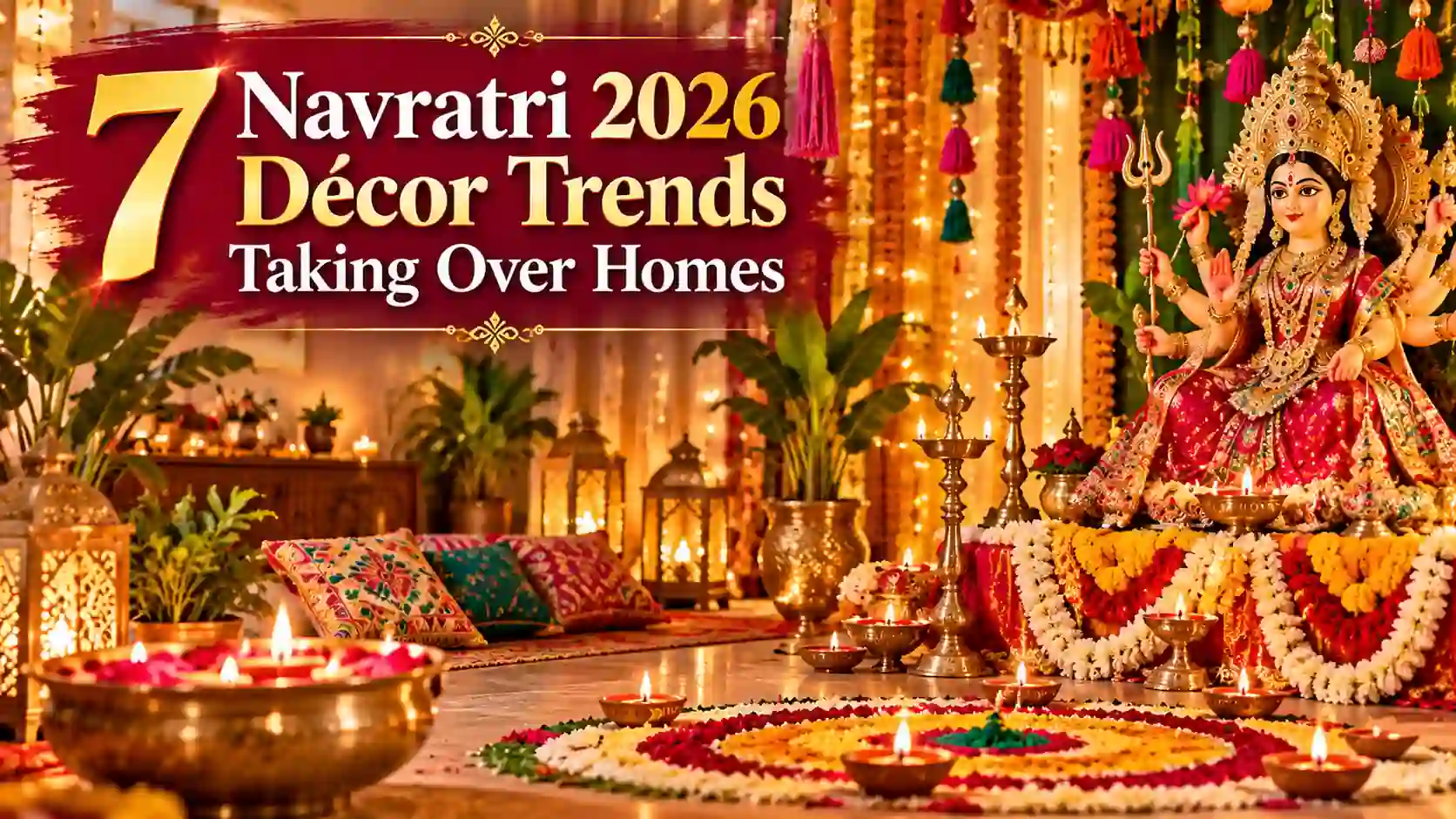
The Navratri decoration ideas that feel freshest this season aren’t imported party themes. They come from India’s own craft traditions: Kutch’s mirror-studded Lippan art, terracotta garba lamps, Bandhani and Phulkari textiles, South Indian Golu steps and torans of marigold and mango leaves. With Navratri 2026 beginning on Sunday, 11 October, here are seven décor directions that suit a puja corner, a living room or a full housing-society celebration, along with what each one means.
1. Lippan Art Behind the Altar
Lippan, sometimes called mud-and-mirror work, is a wall craft from the Kutch region of Gujarat in which small mirrors are set into raised patterns of clay. Ready-made Lippan panels on MDF are now easy to find, and a single round panel placed behind the image of the Goddess catches the lamp light beautifully at evening aarti. It also connects naturally with Gujarat’s Garba tradition.
2. Terracotta Garbo Lamps
The garbo is the perforated clay pot with a lamp inside around which Garba is traditionally danced. Hand-painted garbo pots, or simpler perforated clay lanterns, make thoughtful centrepieces for a home, and they are a way of bringing the meaning of Garba indoors even if you don’t dance. Use a ghee or oil diya inside, or an LED tealight if the pot will be near fabric or children.
3. Textile Backdrops: Bandhani, Phulkari and Ajrakh
Instead of synthetic satin drapes, many households are pinning up an old Bandhani dupatta, a Phulkari, or a length of Ajrakh as the backdrop for the chowki. Red, the colour most associated with the Goddess’s chunri, is the classic choice. These fabrics look richer in photos, can be reused every year, and often carry family memories of their own.
4. Marigold and Mango-Leaf Torans
A toran or bandhanwar across the main door is one of the oldest festive decorations in Indian homes. Fresh marigolds with mango leaves remain the traditional choice, since mango leaves are also used on the kalash itself. Fresh torans wilt within a few days, so many families now use a fabric or beaded toran for the full nine days and add a fresh strand on Ghatasthapana and Ashtami.
5. Golu-Inspired Step Displays
In Tamil Nadu, Karnataka and Andhra Pradesh, Navratri is the season of Golu or Bommai Kolu: an odd number of steps, often five, seven or nine, arranged with dolls of deities, saints and scenes from daily life. Families outside the South have started borrowing the idea with a smaller three-step display holding images of the Navadurga. If you try it, place the deities on the top step, as is customary, and keep everyday figures on the lower ones.
6. A Colour-of-the-Day Corner
The popular nine-colour sequence for 2026 runs orange, white, red, royal blue, yellow, green, grey, purple and peacock green. Rather than redecorating the whole room each day, some families keep one small corner, a side table with flowers and a cloth, and change its colour daily. Children enjoy it, and it gives a gentle daily reminder of which form of the Goddess is being worshipped. The colour list is a modern custom, so treat it as a playful addition rather than a rule.
7. Low-Waste, Reusable Décor
Thermocol, plastic flowers and single-use glitter are giving way to brass and copper lamps, clay, cotton and fresh flowers that can be composted. The jaware, the barley sown beside the kalash, become a living decoration that grows through the nine days, and many families plant them or place them in a garden at the end rather than discarding them. Reusing the same pieces year after year also builds a sense of continuity that new décor can’t.
Setting Up the Puja Corner Safely
Navratri décor revolves around lamps, and some households keep an akhand jyoti burning for all nine days. Keep flames well away from curtains, dupattas and paper décor; place lamps on a metal or stone plate; and use a glass chimney for any lamp left burning. Fairy lights should be rated for indoor use and switched off when no one is home. A beautiful corner is only worth it if it is a safe one.
Frequently Asked Questions
When should I put up Navratri decorations in 2026?
Most families clean and decorate on 9 or 10 October so that the altar is ready for Ghatasthapana on the morning of Sunday, 11 October.
Which colour is best for Navratri decoration?
Red is most closely associated with the Goddess and is used for her chunri and the altar cloth. Yellow and orange marigolds are traditional for flowers and torans.
How do I decorate for Navratri in a small apartment?
Focus on one spot: a small chowki with a red cloth, an image of Maa Durga, a lamp, the kalash and a fresh flower garland. A toran on the main door completes the look without crowding the space.
What should I do with decorations after Navratri?
Compost fresh flowers, plant or respectfully immerse the jaware, and store fabrics and lamps for next year. Many of the same pieces can carry over to Diwali on 8 November 2026.
Navratri Decoration Ideas That Carry Meaning
The most striking Navratri homes are rarely the most expensive ones. They use materials with a story, keep the Goddess at the centre, and leave room for the lamp to do the real work. For rituals, dates and the nine goddesses, see our Navratri 2026 celebration guide, and to understand the lamp at the heart of Garba, read why we celebrate Garba in Navratri.