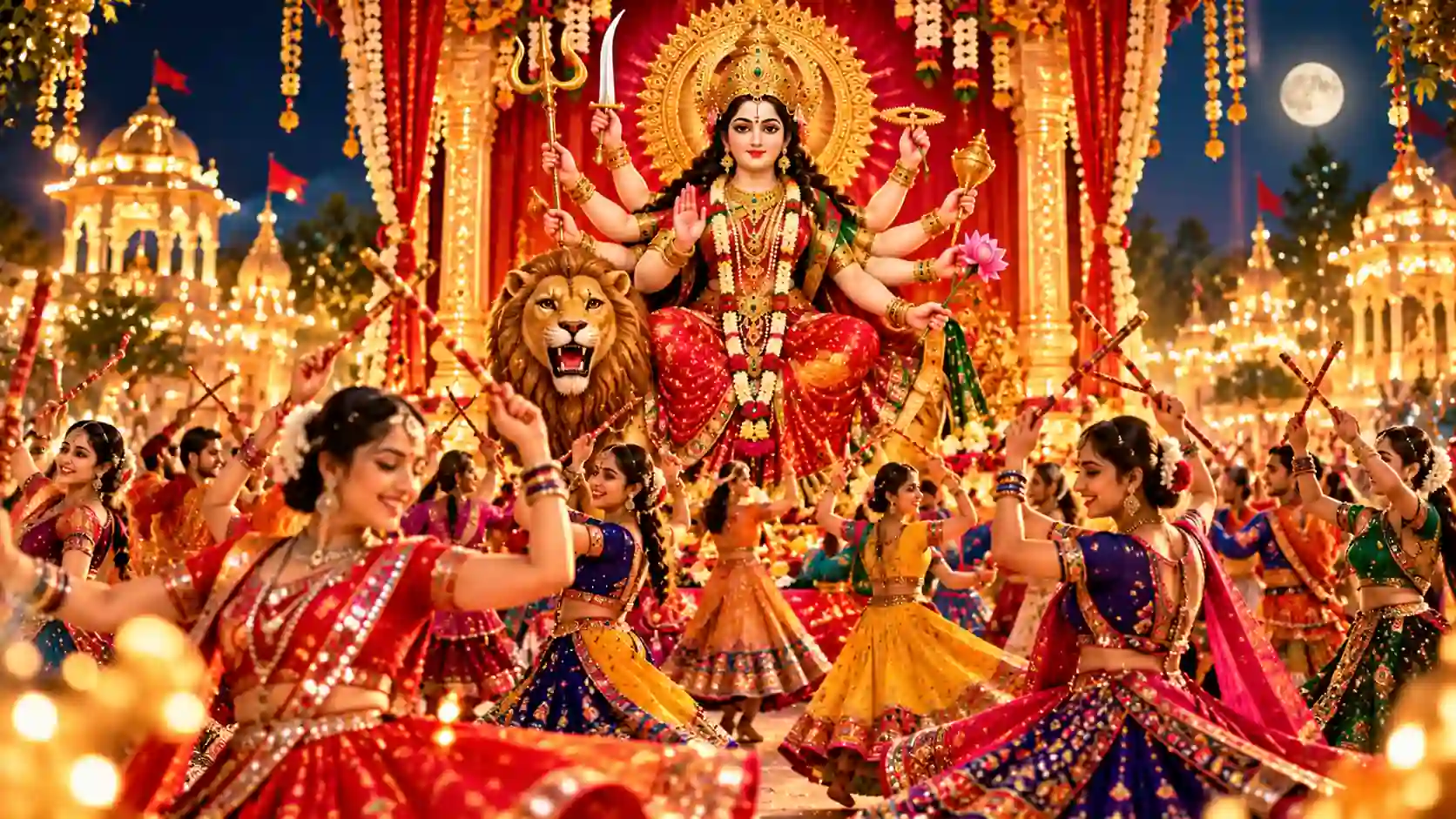
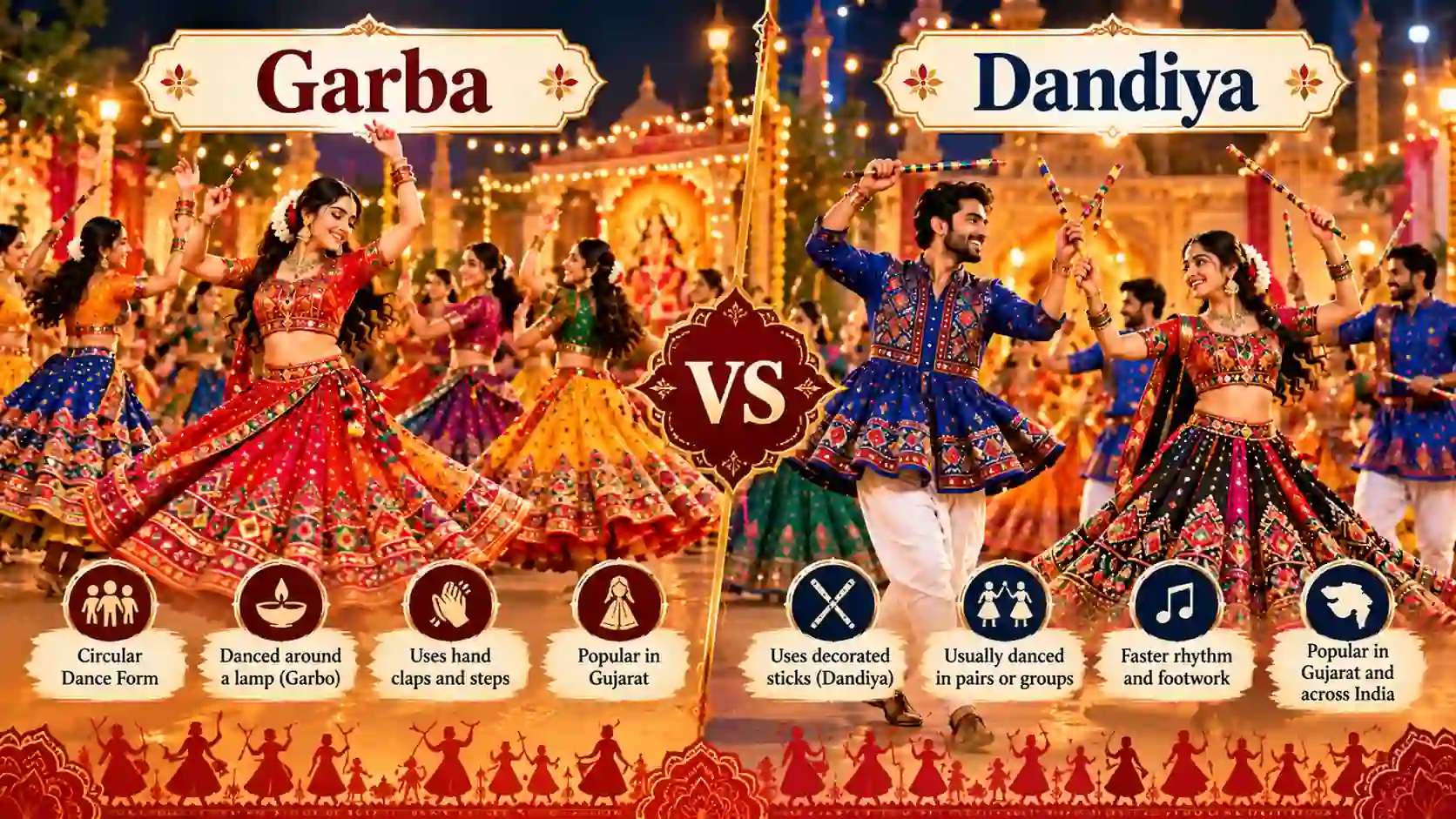
The short answer to Garba vs Dandiya is that neither dance “wins”. They are two parts of the same Navratri night. Garba is a devotional circle dance performed with claps and turns around a lamp or an image of the Goddess, and is usually danced first. Dandiya Raas is danced with a pair of decorated sticks, often face to face with a partner, and traditionally follows later in the evening. When Navratri 2026 begins on 11 October, most celebrations from Ahmedabad to Toronto will include both.
Here’s how they differ, where each comes from, and how to enjoy both.
Garba vs Dandiya at a Glance
| Garba | Dandiya Raas | |
|---|---|---|
| Props | None; hand claps and finger snaps | Two decorated wooden sticks (dandiyas) |
| Formation | Concentric circles moving around a central lamp or image | Pairs facing each other in lines or rotating circles |
| Focus | Devotion to the Goddess (Amba / Durga) | Rhythm, interaction and the Raas tradition |
| Timing | Usually first, often after the evening aarti | Usually later in the night |
| Recognition | “Garba of Gujarat” on UNESCO’s Intangible Cultural Heritage list (2023) | A widely performed folk dance of Gujarat and Rajasthan |
What Is Garba?
The word Garba is commonly linked to the Sanskrit garbha, meaning womb. At the centre of a traditional Garba is the garbo or garba deep, an earthen pot pierced with holes and holding a lit lamp. The light shining through the pot is often understood as a symbol of life within the womb, and of the divine presence within every being. Dancers move around it in widening circles, which many interpret as a picture of the cycle of time with the Goddess at its still centre.
Garba steps are built around claps: two-clap (be taali) and three-clap (tran taali) patterns are the most familiar, with spins and forward-and-back movements added as the tempo rises. Songs are often devotional, addressed to Amba, Bahuchar Maa and other forms of the Goddess. In December 2023, UNESCO inscribed Garba of Gujarat on its Representative List of the Intangible Cultural Heritage of Humanity, recognising it as a living tradition that brings communities together across caste, age and background. Our article on why we celebrate Garba in Navratri explores its devotional meaning in more detail.
What Is Dandiya Raas?
Dandiya Raas takes its name from the dandiya, the pair of sticks each dancer holds. Partners strike sticks in rhythm, then rotate to the next partner, so a single song can bring you face to face with dozens of people. The word raas connects it to the Raas Lila, the dance of Krishna with the gopis of Vrindavan described in the Bhagavata Purana, and Dandiya songs often draw on Krishna themes.
A popular interpretation, repeated widely during Navratri, sees the sticks as the swords of the Goddess in her battle with Mahishasura. This is a modern folk reading rather than something found in scripture, but it helps explain why a Krishna-linked dance became part of a festival centred on Durga: in practice, Navratri in Gujarat absorbed both devotional streams.
Which Comes First?
In many traditional settings, the evening begins with aarti to the Goddess, followed by Garba around the lamp. Dandiya Raas comes later, once the devotional part of the night is complete. Large commercial events often mix the two freely, but community and housing-society celebrations still tend to keep this order.
Which One Should You Try in 2026?
Choose Garba if…
you’re a beginner, coming alone, or want the more devotional experience. Garba circles are easy to join: follow the person in front of you, start with the two-clap step, and you’ll be part of the circle within a few rounds.
Choose Dandiya if…
you’re with friends or family and enjoy rhythm and interaction. Dandiya needs a little more coordination, so practise the basic four-beat strike with a partner before the night. Hold the sticks loosely and keep your strikes at chest height to avoid knuckle knocks.
What to Wear for Each
For Garba, a flared chaniya choli or a kediyu with dhoti lets you spin freely. For Dandiya, shorter dupattas and secure sleeves matter more, since sticks can catch loose fabric. Comfortable footwear helps with both, and many people dance barefoot at traditional venues. For colour-wise ideas, see our Navratri 2026 outfit ideas.
Frequently Asked Questions
What is the main difference between Garba and Dandiya?
Garba is danced with claps in circles around a lamp or image of the Goddess, while Dandiya Raas is danced with a pair of sticks, usually with partners facing each other.
Is Garba older than Dandiya?
Both are old folk traditions of western India, and reliable historical dates for either are hard to establish. What is clear is that Garba is more closely tied to Goddess worship, while Dandiya draws on the Raas tradition associated with Krishna.
Is Garba recognised by UNESCO?
Yes. “Garba of Gujarat” was inscribed on UNESCO’s Representative List of the Intangible Cultural Heritage of Humanity in December 2023.
Can anyone join a Garba circle?
Generally, yes. Community Garba is known for welcoming people of all ages and backgrounds. Follow the venue’s dress code and join the outer circle if you’re new.
The Real Winner
Garba holds the devotional centre of the night; Dandiya brings the celebration outward, from one partner to the next. Dance both. With Navratri 2026 running from 11 to 19 October, you’ll have nine nights to get the steps right. For dates and rituals, see our Navratri 2026 celebration guide, and for regional variations read Navratri Celebrations Across India.