Onam 2026 is not simply a festival marked by flowers, feasts and new clothes. It is an emotion that brings families together, fills homes with the fragrance of traditional food and reminds people of a legendary king whose greatest strength was his love for his people.
In 2026, Thiruvonam, the main day of Onam, will be celebrated on Wednesday, August 26. The traditional ten-day celebration begins with Atham on August 17 and concludes with Thiruvonam.
For people across Kerala and Malayali communities around the world, Onam is a time to return home, reconnect with family and celebrate the values of prosperity, equality, generosity and togetherness.
What Is Onam?
Onam is Kerala’s most important and widely celebrated festival. It is traditionally associated with the annual homecoming of King Mahabali, the legendary ruler remembered for his generosity and the prosperity of his kingdom.
According to Hindu tradition, Mahabali was a powerful and generous Asura king. His kingdom was said to be so prosperous that people lived without fear, poverty or discrimination. Everyone was treated with dignity, and the king was deeply loved by his subjects.
His growing popularity and spiritual power eventually attracted the attention of the gods. Lord Vishnu appeared before Mahabali in the form of Vamana, a dwarf Brahmin.
Vamana asked the king for three paces of land. Mahabali agreed.
Vamana then assumed a cosmic form. With his first step, he covered the earth. With his second, he covered the heavens. There was nowhere left for the third step.
Mahabali, true to his word, offered his own head.
Moved by his devotion, honesty and generosity, Lord Vishnu granted him a special blessing: Mahabali would be allowed to return once every year to visit his beloved people.
That annual homecoming is traditionally associated with Onam.
When Is Onam 2026?
The main day of Onam, Thiruvonam, falls on Wednesday, August 26, 2026. The ten-day celebration begins with Atham on August 17.
The important days are:
- Atham: August 17, 2026
- Chithira: August 18
- Chodhi: August 19
- Vishakam: August 20
- Anizham: August 21
- Thriketta: August 22
- Moolam: August 23
- Pooradam: August 24
- Uthradam / First Onam: August 25
- Thiruvonam: August 26
Kerala’s official 2026 government diary also lists First Onam on August 25, Thiruvonam on August 26, Third Onam on August 27 and Fourth Onam on August 28.
The Ten Days of Onam
One of the most beautiful things about Onam is that it is not limited to a single day.
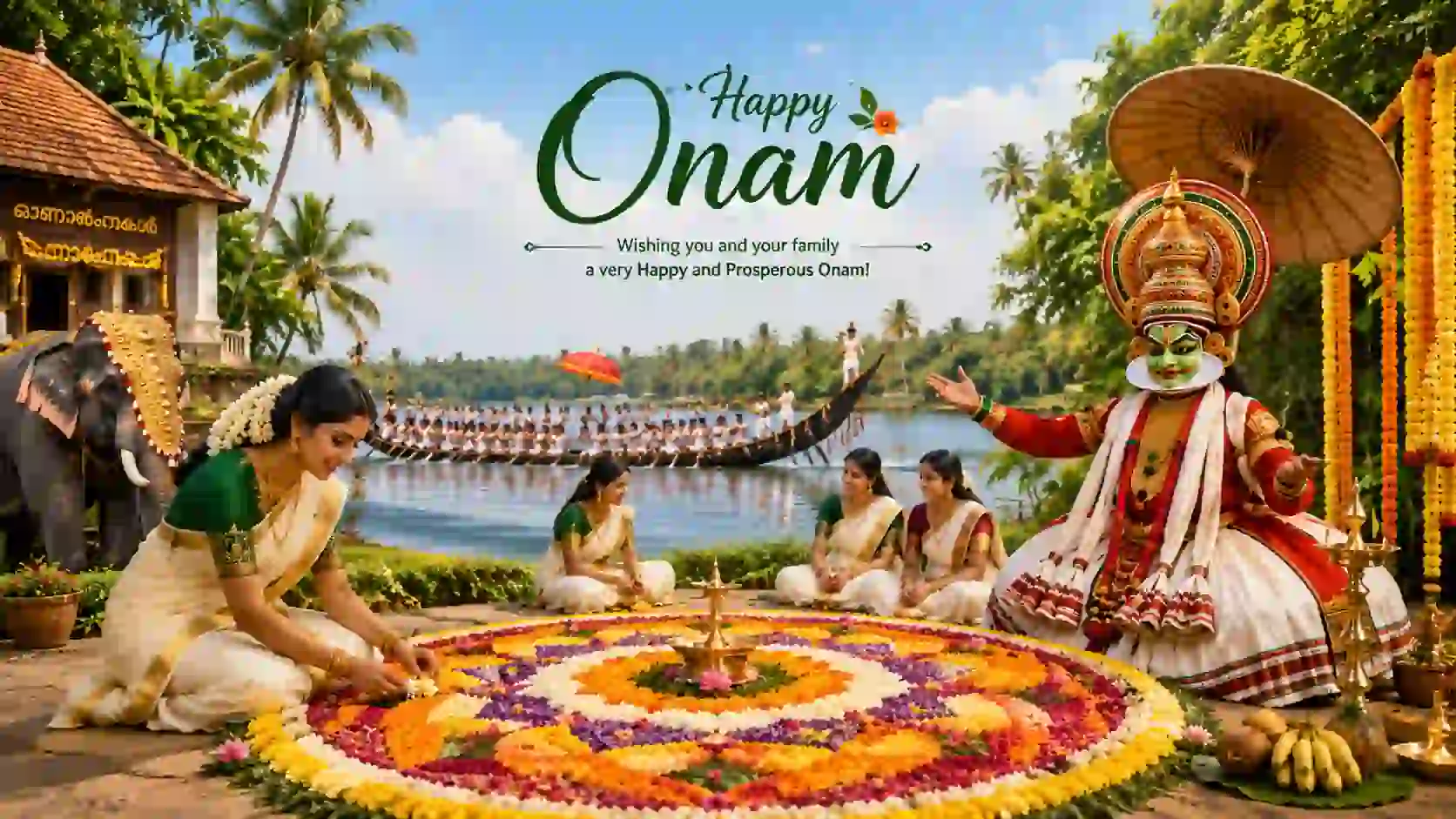
The celebration develops gradually over ten days. During the early days, people begin decorating their homes and creating Pookalam, colourful floral designs traditionally made at the entrance of the house.
As the days progress, the designs become larger and more elaborate. Families, neighbours and communities often come together to create them.
For many people, this is one of the most memorable parts of Onam. Children collect flowers, elders guide the designs and everyone contributes something.
The Pookalam is more than decoration. It represents welcome, beauty, devotion and the joyful anticipation of Mahabali’s arrival.
The Beauty of Pookalam
It is difficult to imagine Onam without colourful flower carpets.
Traditionally, fresh flowers are arranged in circular patterns, although modern Pookalam designs can take many creative forms. Homes are cleaned and decorated before the festival, while floral arrangements become a symbol of festive happiness.
On Thiruvonam, the Pookalam reaches its grandest form. In traditional households, Thrikkakara Appan, representing the presence of Mahabali and the Onam tradition, may also be placed as part of the ceremonial decoration.
Today, Pookalam competitions are also popular in schools, offices and public spaces.
Onam Sadya: A Feast That Brings Everyone Together
If Pookalam represents the visual beauty of Onam, Onam Sadya represents its taste.
Sadya is a traditional vegetarian feast served on a banana leaf. It can include a remarkable variety of dishes, making the meal an experience rather than simply lunch or dinner.
Depending on the household and region, the Sadya may include:
- Rice
- Sambar
- Avial
- Thoran
- Olan
- Kalan
- Erissery
- Pachadi
- Kichadi
- Pickles
- Banana chips
- Sharkara varatti
- Pappadam
- Payasam
- Buttermilk
The meal traditionally brings together different tastes, including sweet, sour, salty, bitter and spicy flavours.
What makes Sadya special is not only the food. It is the way people sit together and eat.
The banana leaf becomes a common table where age, wealth and social position become less important. Everyone shares the same meal.
That simple tradition captures one of Onam’s deepest messages: happiness becomes greater when it is shared.
Onam Celebrations Across Kerala
Onam transforms Kerala into a colourful celebration of art, culture and community.
Traditional dances, music, cultural performances, competitions and processions become part of the festive atmosphere.
One of the most famous traditions associated with Kerala’s festive season is the Vallam Kali, or traditional snake boat race. Long boats filled with rowers move through Kerala’s waterways in spectacular displays of teamwork and rhythm.
Traditional art forms such as Kathakali and Pulikali also add colour to the celebrations. Pulikali, often known as the Tiger Dance, is particularly popular for its energetic performances and striking body painting.
In 2026, public celebrations are again highlighting Kerala’s cultural heritage. Thiruvananthapuram’s Onam tourism celebrations began on August 24 and feature cultural programmes, traditional performances, exhibitions and activities designed to showcase Kerala to visitors.
The Spiritual Meaning of Onam
Behind the music, flowers and food lies a deeper spiritual message.
The story of Mahabali teaches us about humility, sacrifice and keeping one’s word.
Mahabali possessed immense power, but his greatness was remembered because he remained generous. When faced with an extraordinary test, he did not abandon his promise.
Vamana’s story, meanwhile, reminds us that pride and worldly power are temporary.
Onam therefore becomes an opportunity to reflect on an important question:
What makes a person truly great?
According to the traditional story, it is not wealth, power or status. It is character.
Onam and the Idea of Equality
One of the most inspiring aspects of Onam is its emphasis on togetherness.
The traditional image of Mahabali’s kingdom is one where people lived happily and fairly. Whether or not one interprets the story literally, the ideal continues to influence the cultural meaning of the festival.
During Onam, families gather, communities celebrate together and people share food and happiness.
This is why Onam has become meaningful far beyond religious boundaries. It is widely celebrated as a cultural festival of Kerala, with people from different communities participating in its traditions.
Onam Beyond Kerala
Today, Onam is no longer limited to Kerala.
Malayali communities living in cities across India and abroad celebrate it with considerable enthusiasm. Cultural associations organise Sadya, Pookalam competitions, traditional dances and community gatherings.
For Malayalis living far from home, Onam can be especially emotional.
A simple flower arrangement or a plate of Sadya can bring back memories of childhood, grandparents, family homes and rainy days in Kerala.
The festival has therefore become a bridge between generations.
Children may experience Onam differently from their grandparents, but the essential message remains the same.
Why Onam Still Matters in 2026
Life in 2026 is very different from the world in which many of these traditions developed.
People live in crowded cities. Families may be separated by thousands of kilometres. Technology has changed how people communicate and celebrate.
Yet Onam continues to feel relevant.
Perhaps that is because its central message has not changed.
Come together. Share what you have. Remember your roots. Respect others. Celebrate life.
Even a modern Onam celebration can preserve these values.
A family may order ingredients online, create a Pookalam using flowers bought from a market, attend a virtual cultural programme or celebrate Sadya away from Kerala. The form may change, but the feeling remains.
How Onam Can Be Celebrated Meaningfully
Onam does not have to be an extravagant celebration.
A meaningful celebration can be simple:
Clean and decorate the home.
Create a small Pookalam.
Wear traditional clothes.
Prepare or share a Sadya.
Visit relatives and friends.
Teach children the story of Mahabali and Vamana.
Support local artisans and farmers.
Donate food or essentials to someone who needs them.
Most importantly, spend time with people who matter.
After all, the heart of Onam is not about how much we spend. It is about how much happiness we create around us.
Onam 2026: A Festival of Homecoming
Perhaps the most beautiful word associated with Onam is homecoming.
According to tradition, Mahabali returns to see his people. In a similar way, Onam encourages people to return to their own emotional homes—their families, memories, traditions and cultural roots.
For someone living in another city, homecoming may mean travelling hundreds of kilometres.
For someone living abroad, it may mean preparing Sadya with friends.
For a child, it may simply mean sitting beside grandparents and listening to the story of Mahabali.
Every version of Onam is different, yet each carries the same warmth.
Onam 2026 arrives with the familiar fragrance of flowers, the colours of Pookalam, the sound of traditional music and the wonderful promise of a family feast.
But beneath all these celebrations is a timeless story.
The story of a king who was remembered not because he conquered the world, but because he won the hearts of his people.
The story of a divine encounter that transformed pride into humility.
And the story of a festival that continues to bring people together generation after generation.
Onam reminds us that prosperity is meaningful when it is shared, food tastes better when enjoyed together, traditions survive when passed to children and happiness becomes richer when everyone has a place in the celebration.
As Kerala welcomes Thiruvonam on August 26, 2026, the spirit of Onam once again comes alive—not merely in homes and temples, but wherever people gather with love, gratitude and an open heart.
May Onam 2026 bring peace, prosperity, good health, happiness and togetherness to every home.
Happy Onam! 🌼🌿