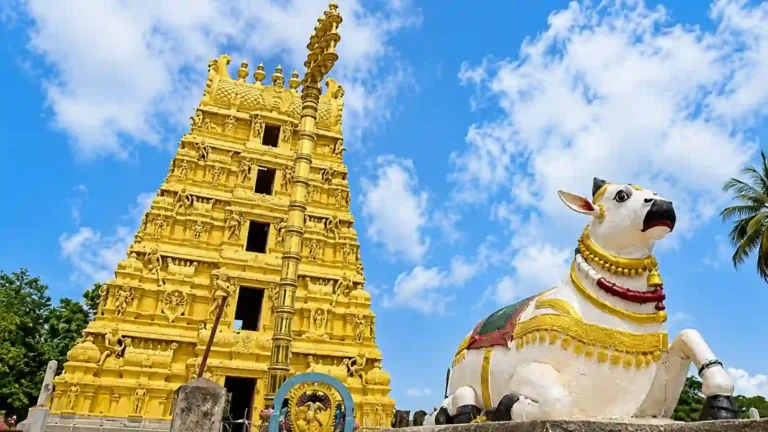

Bahula Devi Temple (Shakti Peeth)
Purba Bardhaman, West Bengal
One of the 12 Jyotirlingas of Lord Shiva and one of the Char Dham pilgrimage sites, nestled in the lap of the Himalayas at an altitude of 3,583 meters.
Location
Purba Bardhaman, West Bengal
Full Address
Bahula Devi Temple, Ketugram, near Katwa, Purba Bardhaman District, West Bengal – 713130, India
Latitude
23.596°N
Longitude
88.117°E
Built By/ Era
Exact founding date and builder unknown; the present idol of the goddess is described as very old, with the temple structure reflecting a modest, traditional Bengal style maintained over generations by local rulers and devotees
Elevation
Approximately 20–25 metres above sea level, consistent with the low-lying Ajay River basin of the Bengal plains
Associated Deity
Lord Shiva (Jyotirlinga)
Opening Time
6:00 am
Closing Time
10:00 pm
Timing Notes
Generally open through the day from 6:00 AM to 10:00 PM for darshan, without a fixed midday closure at this community-run shrine
Overview
On the quiet banks of the Ajay River, in the village of Ketugram in West Bengal’s Purba Bardhaman district, sits a modest yet deeply revered shrine dedicated to Goddess Bahula — one of the 51 Shakti Peethas that trace their origin to the Puranic legend of Sati’s sacrifice. Unlike the grander, more architecturally elaborate Peethas found elsewhere in India, Bahula Devi Temple carries its significance quietly, through age, continuous local devotion, and a striking central idol rather than scale or ornamentation.
Here, tradition holds, the left arm of Goddess Sati fell to earth after Vishnu’s Sudarshan Chakra divided her body, following her self-immolation at her father Daksha’s yajna and Shiva’s grief-stricken journey carrying her remains across the cosmos. The temple’s very name reflects this legend directly — “Bahu” being the Sanskrit word for arm — while also carrying a second meaning of abundance and prosperity, a duality local devotees often point to as fitting for a goddess widely believed to answer prayers generously.
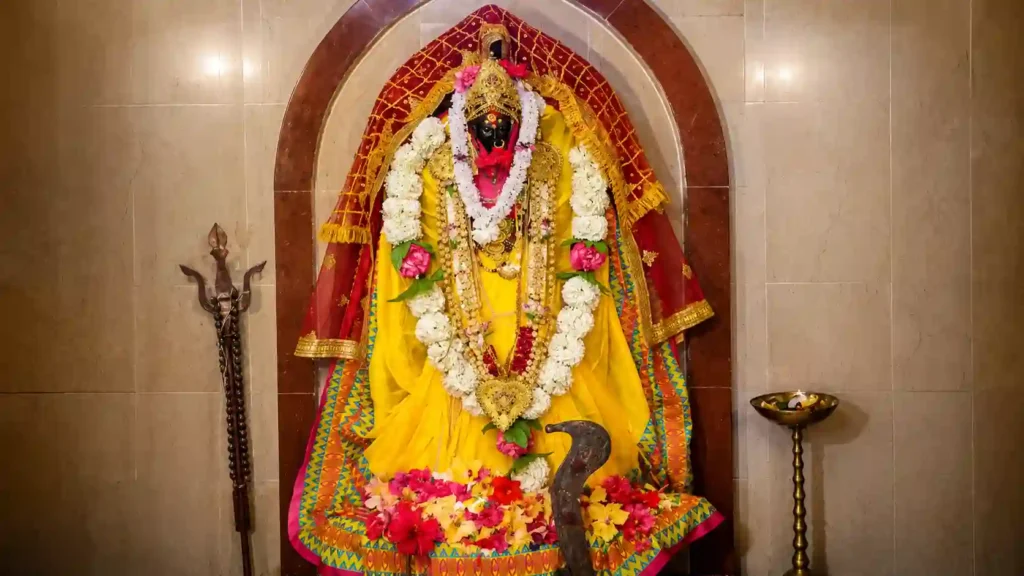
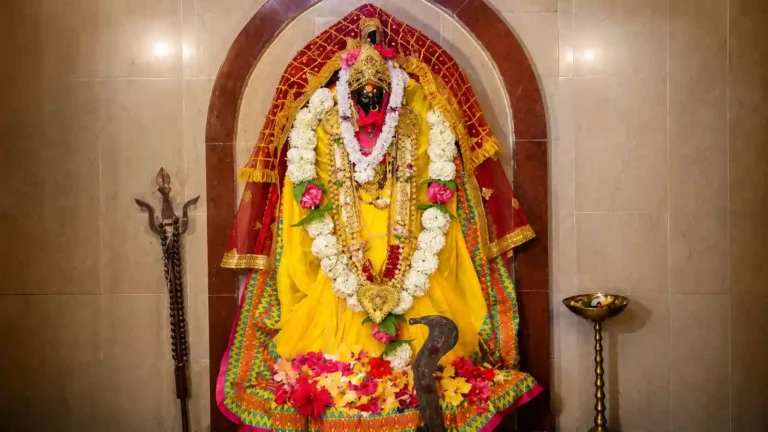
What makes Bahula distinctive among Bengal’s Shakti Peethas is its intimate, riverside setting and its old, unusually detailed central idol — four-armed, with one arm deliberately shown broken, a visual detail devotees connect directly to the temple’s founding legend. The goddess is worshipped here alongside Lord Shiva in his Bhairava form as Bhiruk, whose name is traditionally understood to mean one who has attained the deepest levels of meditative accomplishment.
Notes
Unusually among Shakti Peethas, the temple’s own idol of Devi Bahula is four-armed, with one arm shown broken — a striking visual echo of the very legend the temple is built upon.
The Bhairava associated with this Peetha, Bhiruk (or Bhiruka), is not physically present within the Bahula temple itself; local tradition places him at a nearby location called Srikhandha, where he is worshipped under the name Bhoothnath.
Devi Bahula is depicted here flanked by Ganesha on one side and Goddess Lakshmi on the other, and in some local traditions is described as accompanied by her sons Kartikeya and Ganesha — a detail devotees find meaningful given Sati’s own story predates her sons’ birth in mainstream Puranic tradition.
The name “Bahula” draws from the Sanskrit “Bahu” (arm), while also carrying the separate meaning of “abundant” or “lavish,” reflecting the prosperity many devotees credit to the goddess.
The temple has a strong local reputation as a wish-fulfilling shrine, with many devotees reporting that their prayers here are answered.
The temple is comparatively less crowded than major Shakti Peethas outside festival periods, making it a peaceful destination for those seeking a quieter pilgrimage experience.
Basic accommodation is limited near the temple itself; most visitors stay in nearby Katwa or Bardhaman town.
⛰ 12 Jyotirlingas
🕉 Char Dham
✨ Sacred Place
History
Like many of Bengal’s smaller, community-rooted Shakti Peethas, Bahula Devi Temple’s precise founding date and the identity of its original builders are not preserved in any single historical record. What has endured instead is scriptural memory: the Peetha Nirnaya Tantra, an ancient text enumerating the Shakti Peethas, explicitly names Bahula as the site where Devi’s left arm (Vama Bahu) fell, and identifies the presiding Bhairava here as Bhiruka — a verse still recited by pilgrimage scholars and devotees today as the scriptural basis for the shrine’s sanctity.
The temple’s broader origin, like all Shakti Peethas, traces back to the well-known Puranic account of Sati and her father, King Daksha. According to the legend, Daksha organised a grand yajna and deliberately excluded his daughter Sati and her husband Shiva from the invitation, a calculated insult born from his long-standing disapproval of their marriage. Sati, distressed by the humiliation, attended regardless and, upon facing further public insult from her father, immolated herself in the sacrificial fire in protest. Devastated, Shiva carried her body across the universe in his grief-fuelled Rudra Tandava, until Vishnu, to restore cosmic balance and end Shiva’s anguish, used his Sudarshan Chakra to cut the body into pieces. Each fragment, falling to a different location across the Indian subcontinent, gave rise to a Shakti Peetha — at Ketugram, tradition holds it was her left arm.
Over the centuries, local rulers and generations of devotees are understood to have maintained and periodically renovated the shrine, preserving its sanctity even as its architecture remained modest by design, reflecting simplicity rather than grandeur, in keeping with the character of many older rural Bengal temples. The temple’s reputation as a place where devotees “never leave empty-handed” appears to have grown organically over generations of local testimony rather than through any single documented event, cementing its place as a heavily trusted, if understated, pilgrimage site in the region.
Temple Timings
Opening Time
6:00 am
Closing Time
10:00 pm
Aarti Timings
Morning Aarti
Evening Aarti
Timing Notes
How to Reach
By Air: The nearest major airport is Netaji Subhas Chandra Bose International Airport in Kolkata, roughly 190 km away, offering extensive domestic and international connections. From Kolkata, road travel completes the journey to Ketugram.
By Train: The nearest railway station is Katwa, roughly 8 km from the temple, connected to Bardhaman and onward rail networks. From Katwa station, local transport — taxis, autos, or cycle rickshaws — covers the remaining distance to the temple.
By Road: Ketugram is well connected to Bardhaman town, roughly 56–68 km away, and to Katwa by regular local transport. From Kolkata, the drive covers approximately 190 km. Once in Ketugram, the temple is located about 500 metres from the Ketugram bus station, making the final approach easy on foot or by a short rickshaw ride.
Nearby Places
Frequently Asked Questions
Kedarnath Temple is famous as one of the 12 Jyotirlingas and part of the Char Dham pilgrimage.
It is believed to have been built by the Pandavas and later reconstructed by Adi Shankaracharya.
The temple closes due to heavy snowfall making the region inaccessible; the deity is moved to Ukhimath.
The temple is open from May to October, with pleasant weather during these months.
Via road to Gaurikund, followed by a 16 km trek, or by helicopter services available seasonally.
You Might Also Like -
Bahula Devi Temple (Shakti Peeth)
Attahas Temple (Phullara Shakti Peeth), Birbhum
Amarnath Cave (Mahamaya Shakti Peetha)
Somnath Temple