
Attahas Temple (Phullara Shakti Peeth), Birbhum
Labhpur, Birbhum , West Bengal
One of the 12 Jyotirlingas of Lord Shiva and one of the Char Dham pilgrimage sites, nestled in the lap of the Himalayas at an altitude of 3,583 meters.
Location
Labhpur, Birbhum , West Bengal
Full Address
Attahas Temple (Fullara/Phullara Devi Shakti Peeth), Dakshindihi, Labhpur, Birbhum District, West Bengal – 731303, India
Latitude
23.810°N
Longitude
87.796°E
Built By/ Era
Exact founding date and builder unknown; the shrine is described as ancient in local tradition, with carved deities, inscriptions, and a terracotta script fragment found at the site still under scholarly study
Elevation
Approximately 35 metres (about 115 feet) above sea level, consistent with the low-lying Labhpur area of the Bengal plains
Associated Deity
Lord Shiva (Jyotirlinga)
Opening Time
Closing Time
Timing Notes
Open year-round for darshan; visitor footfall is heaviest during morning and late-afternoon hours
Overview
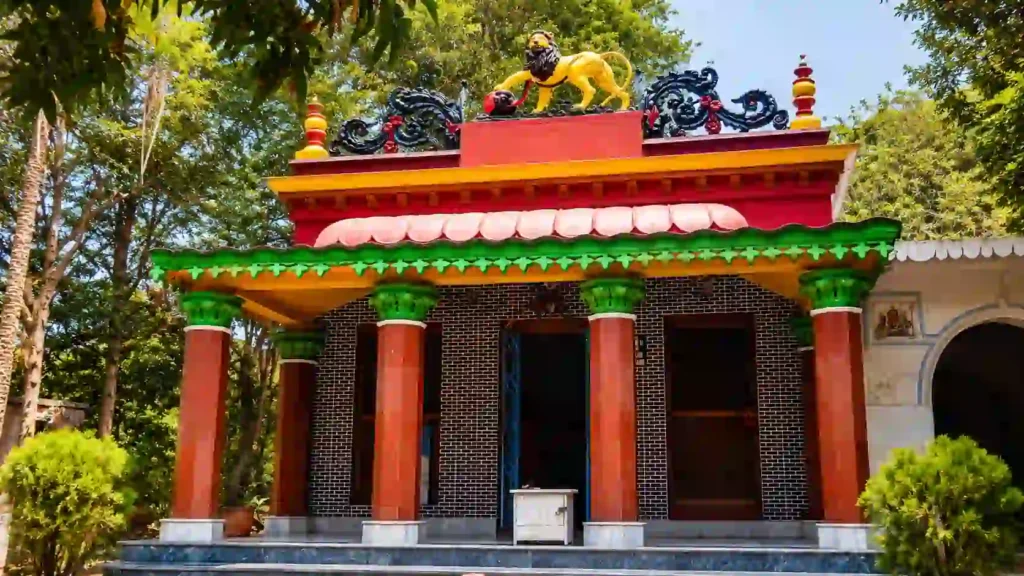
Not every Shakti Peetha announces itself with towering shikharas or sprawling courtyards. Tucked into the quiet village of Dakshindihi, on the gentle banks of the Ishani River near Labhpur in Birbhum district, Attahas Temple is the kind of shrine that reveals itself slowly — in the texture of its carved pillars, in the hush of the surrounding countryside, in a stone larger than most doorways that serves, without embellishment, as the goddess herself.
Attahas is one of the 51 Shakti Peethas, the sacred sites across the Indian subcontinent associated with the scattered remains of Goddess Sati following her self-immolation. Here, tradition holds, her lower lip fell to earth — an origin story reflected quite literally in the temple’s central object of worship: a stone roughly fifteen to eighteen feet wide, standing in the garbhagriha in place of a conventional idol. The Devi is worshipped here as Phullara, “the Blooming One,” a name that stands in gentle contrast to the tragedy of the Sati legend, and her consort Shiva is present as Bhairava Vishweshwar, “Lord of the Universe.”
What draws pilgrims here isn’t spectacle but atmosphere — a temple that has grown organically over generations of local devotion rather than royal patronage, set among fields, birdlife, and the slow rhythms of rural Bengal, offering a very different pilgrimage experience from the grand Jyotirlinga complexes of North and South India.
Unlike most temples, there is no anthropomorphic idol here — the goddess is represented by a large stone, roughly 15 to 18 feet wide, believed to be the fallen lower lip of Sati, and worshipped directly in that form.
The temple’s name, Attahas, comes from Sanskrit words meaning “extreme” or “loud laughter” — an evocative name for a site tied to the story of Sati’s death, and one local tradition connects to the resonance of divine emotion at the spot rather than sorrow alone.
A river once known to feed a temple pond has largely gone into disuse over time, though the Ishani (also called the Kandor) River still flows close to the shrine.
The site draws its largest crowds during Magh Purnima, when a ten-day fair known as the Phullara Mela is held near the temple, and during Navratri, when Devi worship intensifies.
December is noted locally as a particularly popular period for family visits and picnics near the temple grounds.
Note: there is some regional ambiguity around Attahas — a second site with the same name and legend exists near Ketugram in the neighbouring Purba Bardhaman district. This guide covers the Attahas/Phullara Shakti Peeth situated at Dakshindihi near Labhpur, in Birbhum district, as most classical listings and the Shakti Peetha Stotram associate with Birbhum.
The temple lacks grand architecture or heavy ornamentation; its character comes from age, quiet riverside setting, and continuous local devotion rather than scale.
⛰ 12 Jyotirlingas
🕉 Char Dham
✨ Sacred Place
History
Like several of the smaller Shakti Peethas scattered across rural Bengal, Attahas’s exact founding date and the identity of its original builders remain unrecorded, lost to a history preserved more through oral tradition, temple carvings, and scripture than formal inscription. What is documented is its scriptural standing: the Shakti Peetha Stotram, an ancient hymn enumerating the 51 sacred sites, explicitly names Attahas as the place where Devi’s “Ostha” (lip) fell, and identifies her here as Phullara, with Bhairava as Vishwesh — a verse still recited by devotees and pilgrimage scholars today.
The temple’s broader origin story is rooted in the well-known Puranic account of Sati and Daksha. According to the legend, Sati’s father, King Daksha, held a grand yajna but deliberately excluded her and her husband Shiva from the invitation. Distressed by the insult, Sati attended regardless, and upon facing further humiliation from her father, immolated herself in the sacrificial fire. Grief-stricken, Shiva carried her body across the cosmos in a dance of devastation, until Vishnu, to bring the god’s anguish to an end, cut the body into pieces with his Sudarshan Chakra. Each fragment, falling to different points across the subcontinent, gave rise to a Shakti Peetha — at Attahas, tradition holds it was her lower lip.
A gentler, more local layer of legend surrounds the temple’s now-vanished pond, said to have once sat beside the shrine. According to popular retelling connected to the Treta Yuga, Hanuman is believed to have visited this very pond to gather 108 blue lotuses required for Lord Rama’s worship of Goddess Durga — a story that has, over generations, woven the temple into the wider tapestry of Ramayana-era legend as well as the Shakti Peetha tradition.
Physically, the temple that stands today carries carvings of various gods and goddesses along its walls and pillars, alongside inscribed shlokas, and a terracotta script fragment (Shila Lipi) discovered at the site that continues to be studied by researchers — small clues to a history that has, so far, resisted precise dating, much like many of Bengal’s older rural shrines.
Temple Timings
Opening Time
Closing Time
Aarti Timings
Morning Aarti
Evening Aarti
Timing Notes
How to Reach
By Air: The nearest major airport is Netaji Subhas Chandra Bose International Airport in Kolkata, roughly 184–196 km away, with extensive domestic and international connections. Durgapur Airport, around 114 km away, offers a somewhat closer alternative with more limited flight options. From either airport, road travel completes the journey.
By Train: The nearest railway station is Labhpur, only a few kilometres from the temple, though it sees limited express train service. Ahmedpur Junction, roughly 13 km away, is a larger railhead with better connectivity and is commonly used by pilgrims, who then continue to the temple by local transport.
By Road: Attahas lies on the Labhpur–Ahmedpur road, and the town is well connected to Bolpur–Santiniketan (about 30 km away) and Birbhum’s other towns by regular bus and taxi services. From Kolkata, the drive covers roughly 180–190 km.
Once near Labhpur, local buses, shared autos, or short taxi rides connect travellers to the temple at Dakshindihi village.
Nearby Places
Frequently Asked Questions
Kedarnath Temple is famous as one of the 12 Jyotirlingas and part of the Char Dham pilgrimage.
It is believed to have been built by the Pandavas and later reconstructed by Adi Shankaracharya.
The temple closes due to heavy snowfall making the region inaccessible; the deity is moved to Ukhimath.
The temple is open from May to October, with pleasant weather during these months.
Via road to Gaurikund, followed by a 16 km trek, or by helicopter services available seasonally.
You Might Also Like -

Maa Baglamukhi Temple
Bakreshwar Temple
Bahula Devi Temple (Shakti Peeth)
Attahas Temple (Phullara Shakti Peeth), Birbhum