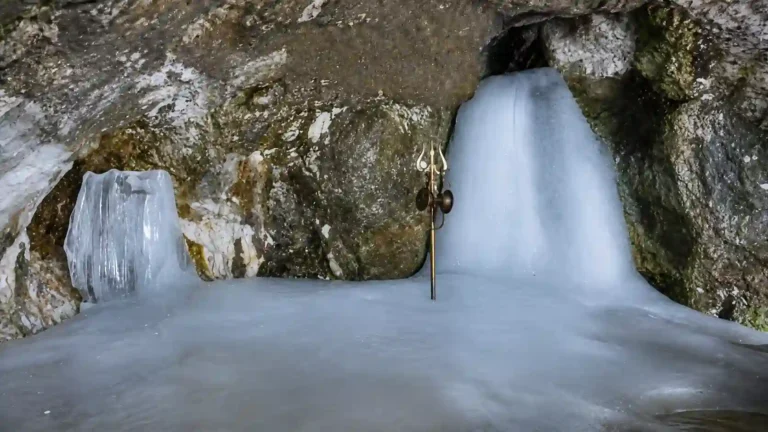

Kedarnath Temple
Uttarakhand
One of the 12 Jyotirlingas of Lord Shiva and one of the Char Dham pilgrimage sites, nestled in the lap of the Himalayas at an altitude of 3,583 meters.
Location
Uttarakhand
Full Address
Shri Kedarnath Temple, Kedarnath, Rudraprayag District, Uttarakhand – 246445, India
Latitude
30.7352° N
Longitude
79.0669° E
Built By/ Era
Legendary origin credited to the Pandavas (Mahabharata era); the present stone structure was revived and rebuilt by Adi Shankaracharya in the 8th century CE. A Gwalior inscription has also led some historians to associate King Bhoja of Malwa (r. 1010–1055 CE) with later temple construction — an alternate, less widely followed view.
Elevation
3,583 metres (11,755 feet) above sea level
Associated Deity
Lord Shiva (Jyotirlinga)
Opening Time
6:00 pm
Closing Time
9:00 pm
Timing Notes
The temple observes an afternoon break, closing from approx. 3:00 PM to 5:00 PM for bhog and rituals. Devotees may touch the idol and perform abhishek before 3:00 PM; after 5:00 PM darshan continues from a respectful distance only. Exact aarti times can shift slightly by season and are set by the Badrinath-Kedarnath Temple Committee (BKTC) — reconfirm close to your visit. The temple itself is only accessible for about six months a year (late April to early November); it is fully closed in winter due to snow, when the deity is ceremonially moved to Omkareshwar Temple, Ukhimath.
Overview
Kedarnath Temple is one of the most revered shrines in Hinduism, dedicated to Lord Shiva and counted among the twelve Jyotirlingas — sites where Shiva is believed to have manifested as a “lingam of light.” Set against snow-capped Himalayan peaks at an elevation of over 3,500 metres, it is also one of the four sites of the Chota Char Dham pilgrimage circuit in Uttarakhand, alongside Badrinath, Gangotri, and Yamunotri.
Unlike most Shiva temples, the deity here is not represented by a smooth Shivalinga but by a rugged, naturally shaped conical rock in the sanctum, worshipped as the hump of the bull form Shiva took to evade the Pandavas. The temple’s remote location and demanding trek have long made a Kedarnath pilgrimage a profound test of faith and endurance for devotees.
The temple gained global attention in June 2013, when catastrophic flash floods devastated the region; remarkably, the temple structure itself survived largely intact, an event widely noted by both scientists and devotees and now part of its living history.
⛰ 12 Jyotirlingas
🕉 Char Dham
✨ Sacred Place
History
Mythological Origin
According to tradition, after the great war of the Mahabharata, the Pandavas were troubled by the guilt of killing their own kinsmen and sought Lord Shiva’s forgiveness. Shiva, reluctant to grant them audience, fled in the form of a bull and hid among cattle in the Garhwal Himalayas. When Bhima recognised him, Shiva dived into the ground, leaving his hump behind at what is now Kedarnath — while his other body parts are said to have appeared at four other sites, together forming the Panch Kedar (five Kedar shrines).
Historical Construction
The earliest textual references to Kedara appear in the Skanda Purana (composed roughly in the 7th–8th centuries CE). Historical consensus credits the philosopher-saint Adi Shankaracharya with reviving and rebuilding the temple in its present stone form in the 8th century CE, as part of his broader revival of the Char Dham pilgrimage tradition across India. Shankaracharya is also said to have taken mahasamadhi (his final departure from the body) just behind the temple, where a memorial now stands.
A separate line of evidence — a stone inscription found in Gwalior, Madhya Pradesh — has led some historians to connect King Bhoja of Malwa (11th century CE) with later temple construction or patronage, though this remains a secondary, less widely followed theory alongside the Adi Shankaracharya account.
Architecture
The temple is built from massive grey stone slabs, interlocked using an ancient dry-stone technique without mortar — a method believed to have contributed to its resilience against earthquakes, floods, and centuries of harsh Himalayan weather. The structure includes a garbhagriha (sanctum), a mandapa (assembly hall), and is oriented north-south rather than the more common east-facing orientation of most Hindu temples. A stone Nandi statue faces the entrance, and the temple walls carry carvings of the Pandavas, Draupadi, Krishna, and Virabhadra.
2013 Floods
In June 2013, unprecedented cloudbursts triggered flash floods and landslides across Uttarakhand, causing widespread destruction around Kedarnath. A massive boulder, since revered as Bhim Shila, is credited with diverting the floodwaters around the temple, which survived largely undamaged even as much of the surrounding town was destroyed. The area has since been substantially rebuilt, and the pilgrimage resumed in the following years.
Temple Timings
Opening Time
6:00 pm
Closing Time
9:00 pm
Aarti Timings
Morning Aarti
Evening Aarti
Timing Notes
How to Reach
By Air
The nearest airport is Jolly Grant Airport in Dehradun, roughly 230–250 km from Gaurikund (the last motorable point before the trek). From the airport, devotees can take a taxi toward Rishikesh, Rudraprayag, and onward to Sonprayag/Gaurikund. Helicopter services are also available seasonally from helipads at Phata, Sirsi, and Guptkashi, reaching Kedarnath in around 7–10 minutes.
By Rail
The nearest railway station is Rishikesh (also called Yog Nagri Rishikesh), around 210–216 km from Gaurikund. Haridwar station is a well-connected alternative, about 235 km away. From either station, onward travel to Gaurikund is by taxi or bus.
By Road
Gaurikund is connected by road via National Highway 109 to Rishikesh, Devprayag, Srinagar, and Rudraprayag. Private vehicles are generally not permitted beyond Sonprayag; a shuttle service covers the final stretch to Gaurikund. From Gaurikund, the temple itself is reached only by a 16–18 km trek (on foot, pony, palanquin/doli, or via helicopter) through Rambara and Garud Chatti, typically taking 6–8 hours.
Note: registration is compulsory for the Char Dham Yatra, including Kedarnath, and biometric registration can be completed online or at counters in Rudraprayag/Sonprayag before starting the trek.
Nearby Places
Frequently Asked Questions
Kedarnath Temple is famous as one of the 12 Jyotirlingas and part of the Char Dham pilgrimage.
It is believed to have been built by the Pandavas and later reconstructed by Adi Shankaracharya.
The temple closes due to heavy snowfall making the region inaccessible; the deity is moved to Ukhimath.
The temple is open from May to October, with pleasant weather during these months.
Via road to Gaurikund, followed by a 16 km trek, or by helicopter services available seasonally.
You Might Also Like -
Maa Baglamukhi Temple
Bakreshwar Temple
Bahula Devi Temple (Shakti Peeth)
Attahas Temple (Phullara Shakti Peeth), Birbhum