


Time Beyond the Clock
In todays life the concept of time and yuga, time is measured in seconds, minutes, and years—linear, finite, and relentlessly moving forward. However, ancient Indian philosophy presents a radically different understanding of time: cyclical, cosmic, and eternal. Hindu cosmology views time as an ever‑repeating wheel, where creation, preservation, destruction, and renewal unfold in vast cosmic rhythms. At the heart of this worldview lies the profound concept of the Yugas—four great ages that define the moral, spiritual, and social condition of humanity.
This blog offers a deep dive into the four Yugas—Satya, Treta, Dvapara, and Kali, with special focus on Kali Yuga, the age we are believed to be living in today, and the prophesied arrival of Lord Kalki, the final avatar of Vishnu. Through scriptures, symbolism, and philosophical insights, we explore how ancient wisdom interprets time, decline, hope, and renewal.
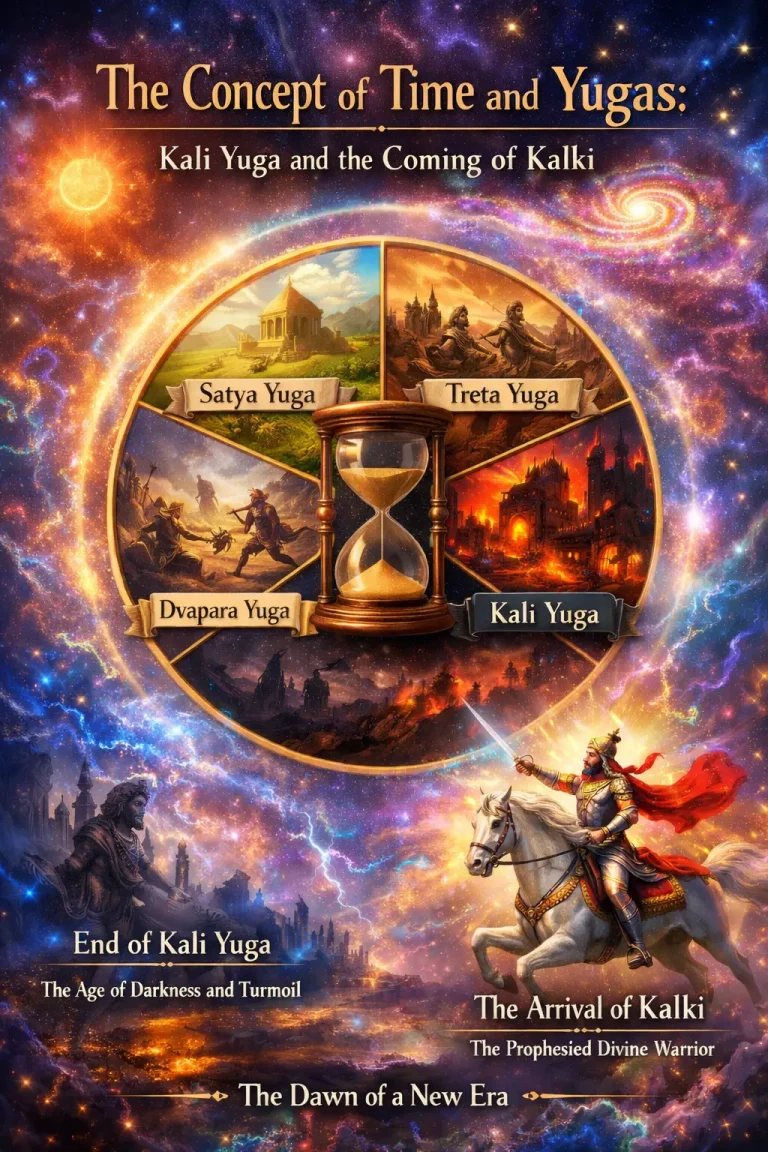
The Cyclical Concept of Time in Hinduism
The linear time concept dominant in Abrahamic traditions, Hinduism envisions time as a cosmic cycle (Kala Chakra). Just as day follows night and seasons repeat annually, the universe itself undergoes endless cycles of creation (Srishti), preservation (Sthiti), dissolution (Pralaya), and rest.
A full cycle of the four Yugas is called a Maha Yuga, which spans 4.32 million human years. One thousand Maha Yugas make up a single day of Brahma, the creator god, emphasizing the staggering scale of cosmic time in Hindu thought.
This cyclical model teaches an important philosophical lesson: decline is inevitable, but so is renewal. Darkness is not permanent; it is always followed by light.
Kali Yuga: Characteristics and Signs
Ancient scriptures such as the Vishnu Purana, Bhagavata Purana, and Mahabharata vividly describe the symptoms of Kali Yuga—many of which resonate strikingly with the modern world.
Key Characteristics of Kali Yuga
-
Truth is replaced by falsehood; dishonesty becomes common
-
Wealth determines status, not virtue or wisdom
-
Leaders lack integrity and exploit power
-
Family bonds weaken; respect declines
-
Spirituality becomes commercialized
-
Humans become physically weaker but mentally restless
-
Desire, anger, greed, and ego dominate
Despite its darkness, Kali Yuga holds a paradoxical blessing: liberation is easiest in this age. Scriptures state that sincere devotion (Bhakti) alone can grant spiritual freedom, without elaborate rituals or severe austerities.
Spiritual Opportunity in Kali Yuga
While Kali Yuga is often portrayed negatively, saints and sages emphasize its hidden potential. The Bhagavata Purana declares:
“ In Kali Yuga their is alot of Sins/faults, but still there is one great quality: simply by chanting the names of the Gods and Mantras one can be liberated.”
Practices such as Naam Japa, Bhakti Yoga, selfless service, and inner awareness are considered powerful tools to transcend the limitations of this age.
The Prophecy of Kalki: The End of Kali Yuga
In a world decaying under the weight of Adharma, the final chapter of the Kali Yuga unfolds. As virtue vanishes and darkness prevails, the prophecy foretells the arrival of Kalki, the tenth avatar of Vishnu.
Mounted on the white horse Devadatta, wielding a blazing sword of stellar light, he emerges from the village of Shambhala. His mission is divine purification: to annihilate the wicked and restore the cosmic order. Through his sword, the cycle of time resets, purging the world of filth to usher in the Satya Yuga—a new age of truth, purity, and eternal light.
Symbolic Interpretation of Kalki
Beyond literal interpretations, many scholars view Kalki symbolically:
The white horse represents purity and speed of truth
The sword symbolizes wisdom that cuts through ignorance
Kalki signifies inner awakening, where divine consciousness destroys ego and illusion
In this view, Kalki’s arrival is not just external but internal—manifesting whenever humanity collectively chooses truth over falsehood.
Are We Near the End of Kali Yuga?
From a scriptural timeline, Kali Yuga has barely completed a fraction of its full duration. However, the intensity of decline, not the passage of years, is often emphasized in spiritual discourse.
Rapid technological advancement, environmental degradation, moral confusion, and spiritual longing suggest that humanity is undergoing a profound transformation—whether interpreted literally or metaphorically.
Relevance of Yuga Theory in the Modern World
The concept of Yugas offers more than prophecy—it provides perspective. It helps individuals understand that chaos and decline are part of a larger cosmic rhythm, not permanent failures.
Key lessons include:
-
Decline is cyclical, not final
-
Individual Dharma still matters
-
Inner transformation precedes societal change
-
Hope is intrinsic to the universe
Time, Hope, and Renewal
The Hindu concept of time and Yugas presents a powerful vision of existence—one where darkness and light alternate, where decline carries the seed of renewal, and where hope is eternal.
Kali Yuga, though challenging, is not a curse but a test of consciousness. The coming of Kalki—whether as a divine being, a collective awakening, or inner transformation—symbolizes humanity’s enduring potential to return to truth.
In understanding the Yugas, we are reminded that while time moves in cycles, our choices within time define our spiritual destiny.